

John William Waterhouse, Artist of Myth and Emotion: The Eternal Grace of the Pre-Raphaelite Imagination
John William Waterhouse (1849–1917) gave the Pre-Raphaelite imagination its most famous faces: heroines from Greek myth, Shakespeare and Tennyson, caught at the exact moment their fate turns. The Lady of Shalott, Hylas and the Nymphs, Pandora, Echo and Narcissus — his canvases are among the most reproduced images in all of Victorian art. This guide covers his life, decodes his style, walks through his major paintings one by one, tells you where the originals hang, and how to bring a faithful reproduction home.
➜ Browse the John William Waterhouse print collection
John William Waterhouse at a glance
- Born: Rome, baptised 6 April 1849, to English painter parents
- Died: London, 10 February 1917 — buried at Kensal Green Cemetery
- Nationality: British (English)
- Movement: late Pre-Raphaelitism, Victorian academic painting, Symbolism
- Training: Royal Academy of Art Schools, London (from 1870)
- Honours: Associate of the Royal Academy 1885, full Royal Academician 1895
- Major works: The Lady of Shalott (1888), Hylas and the Nymphs (1896), Pandora (1896), A Mermaid (1900), Echo and Narcissus (1903), The Soul of the Rose (1908)
- Where to see them: Tate Britain (London), Manchester Art Gallery, Walker Art Gallery (Liverpool), Lady Lever Art Gallery, Art Gallery of South Australia
Who was John William Waterhouse? A short biography
A Roman childhood, a London training
John William Waterhouse was born in Rome in 1849 to two English painters working in Italy. Nicknamed "Nino" by his family, he grew up among studios, ruins and Roman collections — an early immersion that explains the constant presence of antiquity in his work. The family returned to London while he was still a child. In 1870 he entered the Royal Academy of Art Schools, first as a sculpture student, before turning to painting.
The academic years (1870–1885)
His earliest canvases belong to the Victorian appetite for archaeology and classical reconstruction, in the wake of Lawrence Alma-Tadema and Frederic Leighton: large scenes of Greek and Roman daily life, marble, drapery, documentary precision. Consulting the Oracle (1884) and Saint Eulalia (1885), both now at Tate, marked this first peak and won him election as an Associate of the Royal Academy in 1885.
The Pre-Raphaelite turn
From the mid-1880s Waterhouse changed ground. He set aside archaeological staging for poetic narrative: English literature, Arthurian legend, Greek myth reread as inner drama. His palette loosened, his brushwork grew freer — almost impressionist in foliage and water. This is the Waterhouse we know, the painter of The Lady of Shalott (1888), which ties him to the generation of Rossetti, Millais and Burne-Jones even though the Pre-Raphaelite Brotherhood had been founded forty years earlier. He is often called "the last Pre-Raphaelite".
In 1883 he married Esther Kenworthy, herself a flower painter, and settled in the artists' quarter of St John's Wood. He became a full Royal Academician in 1895 and taught at the St John's Wood Art School.
Final years and legacy
Waterhouse painted to the end, in poor health, leaving a last Arthurian canvas unfinished. He died of cancer in February 1917 and rests at Kensal Green Cemetery in London. Long dismissed as old-fashioned by twentieth-century modernist criticism, he has enjoyed a striking rehabilitation since the 1980s: the touring retrospective of 2009 (Groninger Museum, Royal Academy, Montreal) confirmed his return, and his images are now among the most widely shared in all of nineteenth-century art.
Waterhouse's style: five recognisable markers
- A single female figure, seen in psychological close-up. Rarely crowds — one heroine, caught in a moment of choice, doubt or reversal.
- The suspended instant. Waterhouse never paints the action, only the second before it: the hand on the lid, the glance turning away, the chain being released.
- A naturalist setting. Reeds, water lilies, irises, damp moss — the real English landscape hosts the Greek myth.
- Atmospheric light. Veiled skies, verdigris, muted golds. Few violent contrasts, a great deal of moisture in the air.
- An openly literary source. Ovid, Homer, Shakespeare, Keats, Tennyson: every canvas is a page read, then dreamed.
The most famous paintings by John William Waterhouse
The Lady of Shalott (1888)
His best-known painting and one of Tate Britain's icons, held there since Henry Tate's bequest. Waterhouse illustrates Alfred Tennyson's poem: shut in her tower, cursed to see the world only through a mirror, the Lady finally looks at Lancelot with her own eyes — and dooms herself. He paints her in the boat, chain in hand, three candles of which two have already gone out, the tapestry of her own story trailing into the water. An allegory of the cost of art as much as a love tragedy. Monumental in scale (approx. 153 × 200 cm).

➜ Shop The Lady of Shalott print
Hylas and the Nymphs (1896)
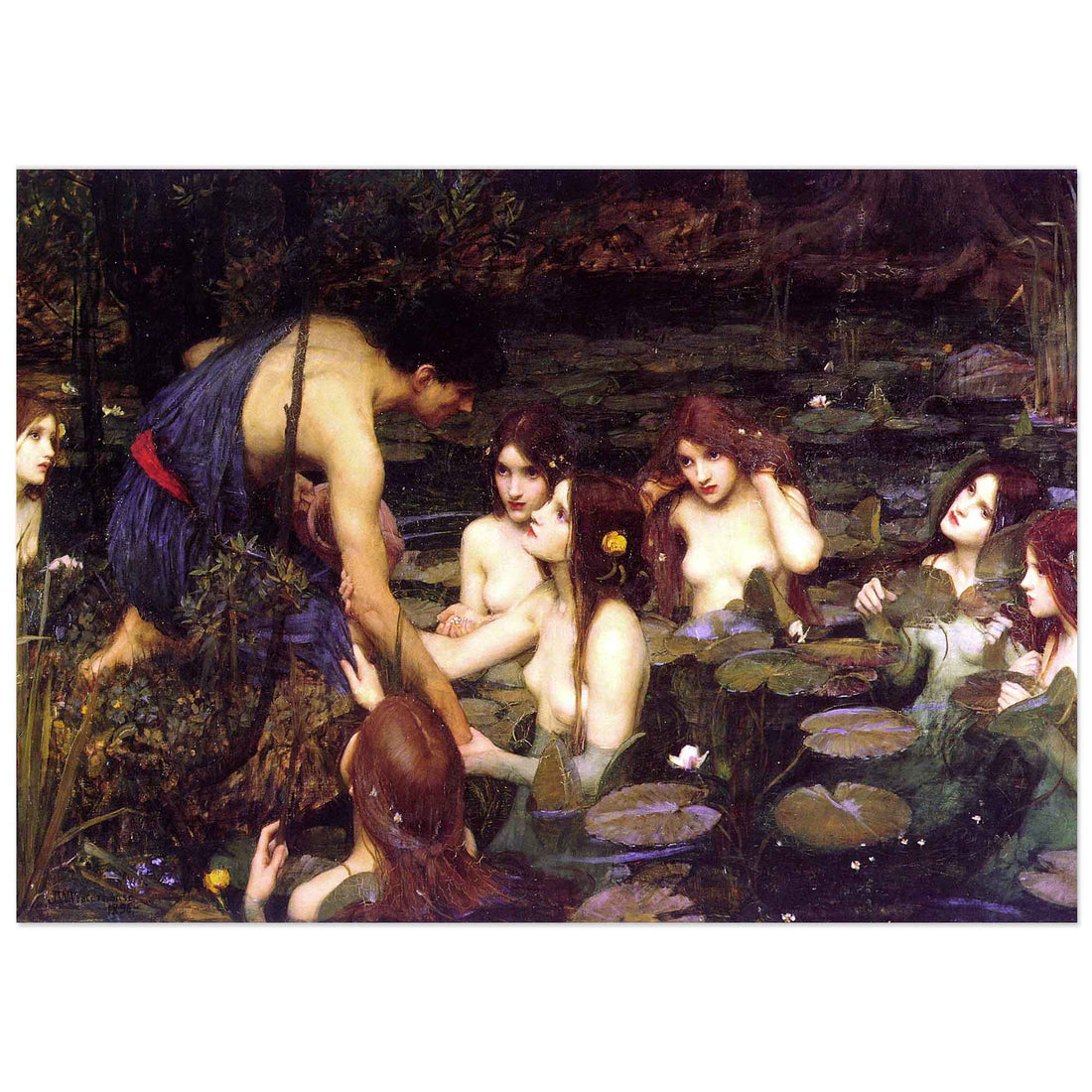
Held at Manchester Art Gallery, this canvas tells an episode from the voyage of the Argonauts: sent to fetch water, young Hylas is drawn down into the spring by seven naiads. Waterhouse builds a spiral of faces and water lilies whose centre is the outstretched hand. The work was briefly removed from display in 2018 in a much-debated intervention, which paradoxically made it one of the most discussed Victorian paintings of the twenty-first century.
➜ Shop the Hylas and the Nymphs print
Pandora (1896)
Waterhouse takes on the most loaded myth in the Greek tradition: the first woman opens the jar that releases every ill into the world. His Pandora is neither villain nor victim — simply curious, kneeling in a glade, her blue gown pulled taut by the movement. The golden light rising from the box makes the scene tragic and sublime at once. A meditation on temptation, knowledge, and what remains at the bottom of the box: hope.

Psyche Opening the Golden Box (1903)
A variation on the same forbidden gesture, this time borrowed from Apuleius. Psyche, entrusted by Venus with a casket she must not open, gives in. Waterhouse concentrates everything in the tilt of the body and the glow rising towards her face: the desire to know, eternal and fatal. Every fold of fabric, every nuance of light shows the artist's devotion to detail.

Boreas (1903)
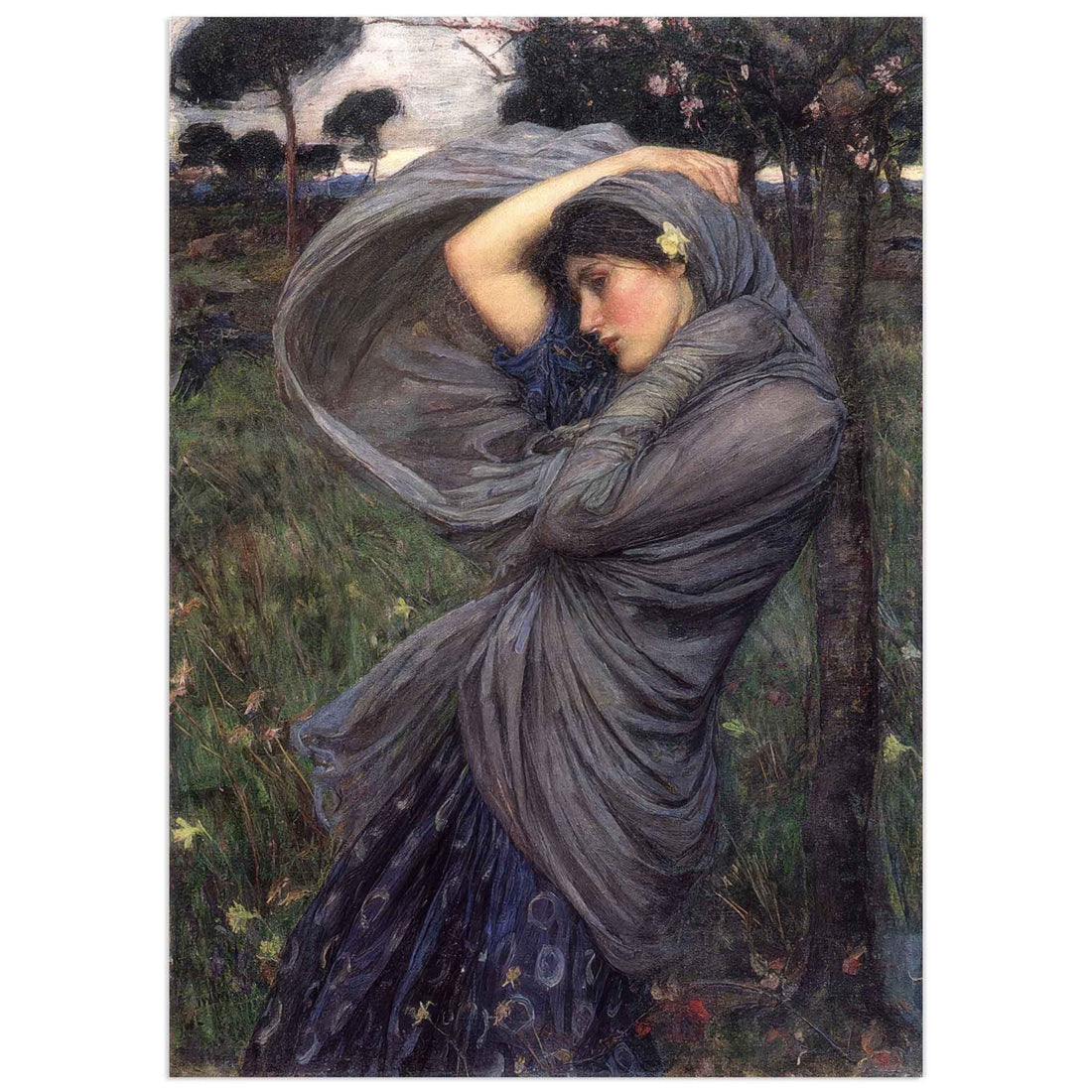
One of Waterhouse's most atmospheric works. A young woman crosses a spring field caught in a gust; her cloak and hair fly up, petals whirl around her. Boreas is the Greek god of the north wind — but he never appears: he exists entirely in the movement of cloth. Motion and melancholy in a single image, with that very English sense of damp freshness.
A Mermaid (1900)
Waterhouse submitted A Mermaid as his diploma work to the Royal Academy, which still holds it. Sitting on the rocks, the mermaid combs her hair in silence, a shell of pearls at her feet. Neither threat nor obvious seduction: a solitary creature between reverie and waiting. The palette of blues, greens and copper makes this one of his most tranquil canvases.

Echo and Narcissus (1903)
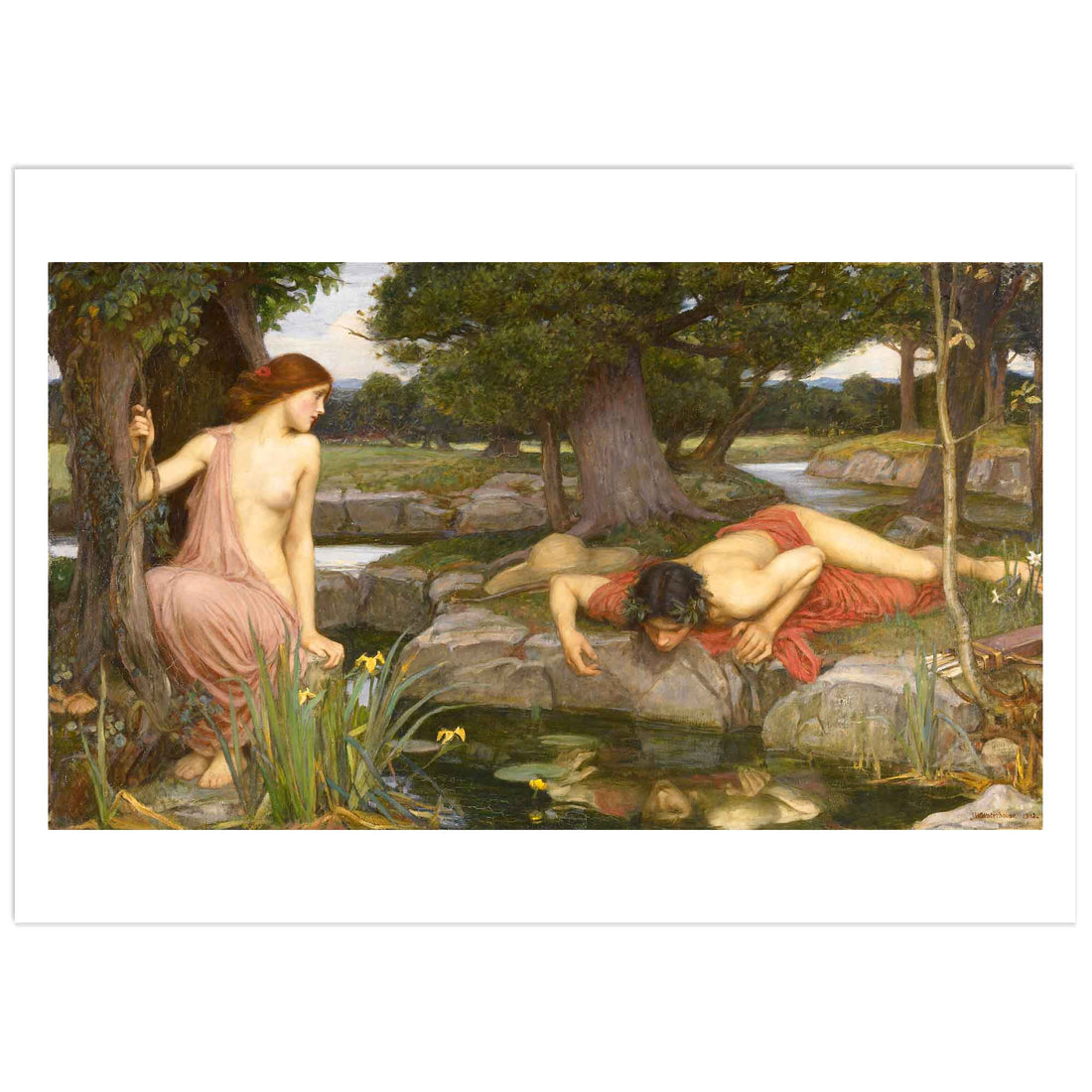
Held at the Walker Art Gallery in Liverpool, this wide horizontal canvas illustrates Ovid: Narcissus, bent over the water, sees only himself; Echo, condemned only to repeat, watches from the far bank. Two solitudes separated by a few metres and a reflection. It is arguably the most subtly constructed composition in his entire output (approx. 109 × 189 cm).
➜ Shop the Echo and Narcissus print
Lamia (1905)
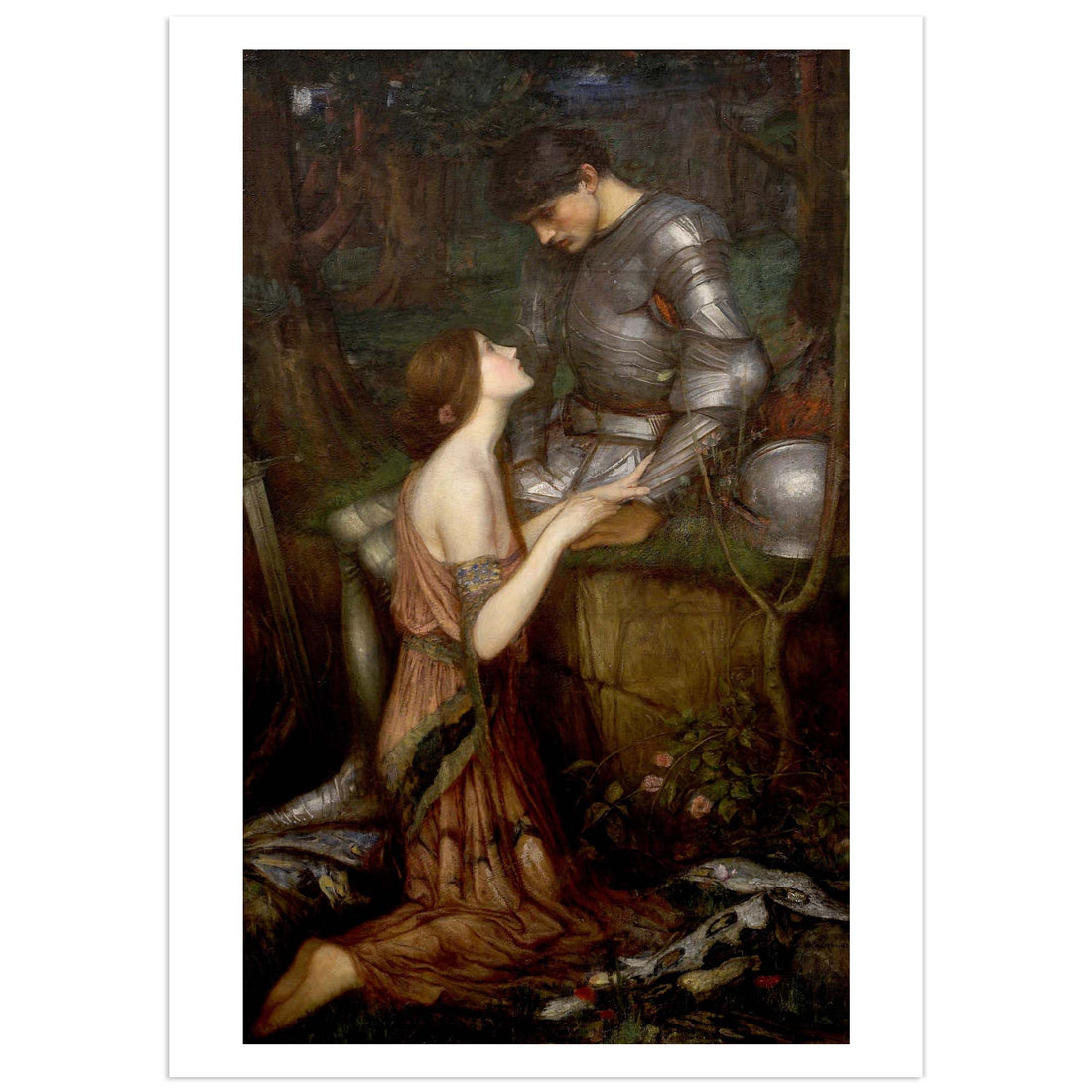
Drawn from John Keats's poem, Lamia is the serpent-woman who has shed her reptilian form to love a mortal. Waterhouse shows her kneeling before a knight, the snakeskin still coiled around her legs like a gown that betrays her. One of his most ambiguous subjects: seduction, metamorphosis, illusion.
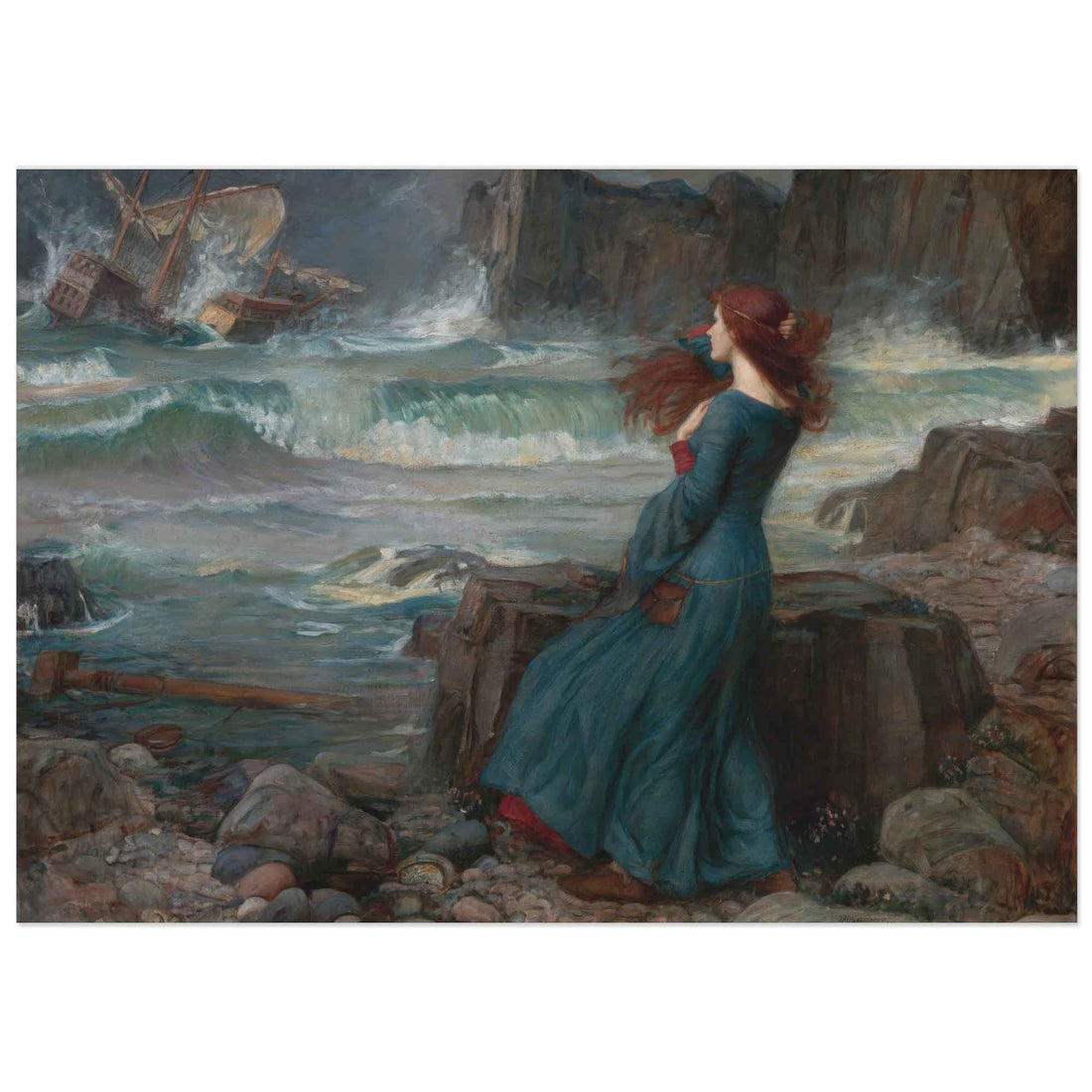
Miranda – The Tempest (1916)
One of his very last canvases, after Shakespeare's The Tempest. Miranda, seen from behind, hair torn by the wind, watches the shipwreck from the shore. Waterhouse ends his career as he conducted it: a woman, a text, a sea.
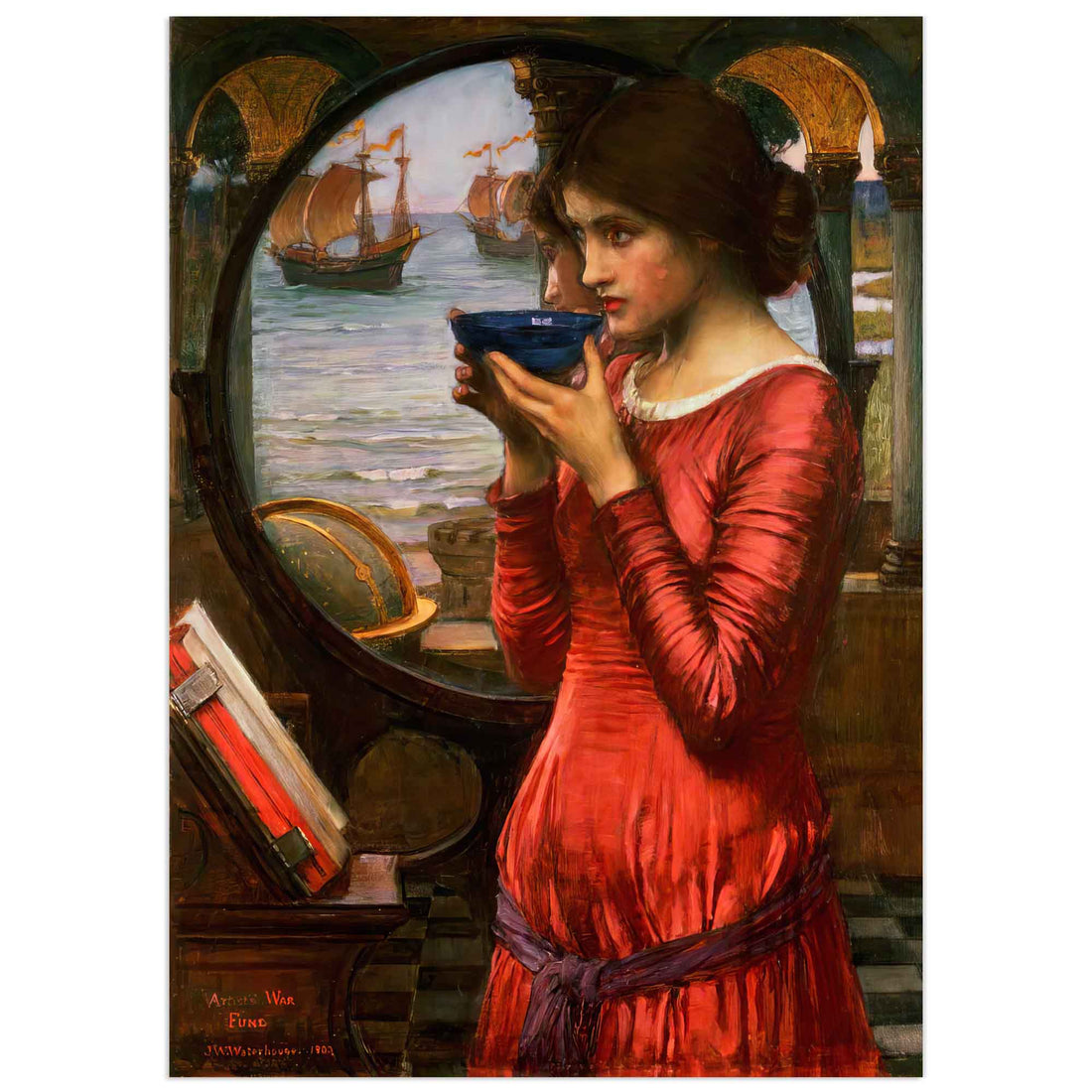
Destiny (1900)
Painted during the Boer War, Destiny shows a woman raising a cup before a mirror while, through the window, a fleet puts to sea. The painting was sold in aid of wounded soldiers. A farewell, a superstition, a toast: Waterhouse condenses into one image the waiting of those who stay behind.
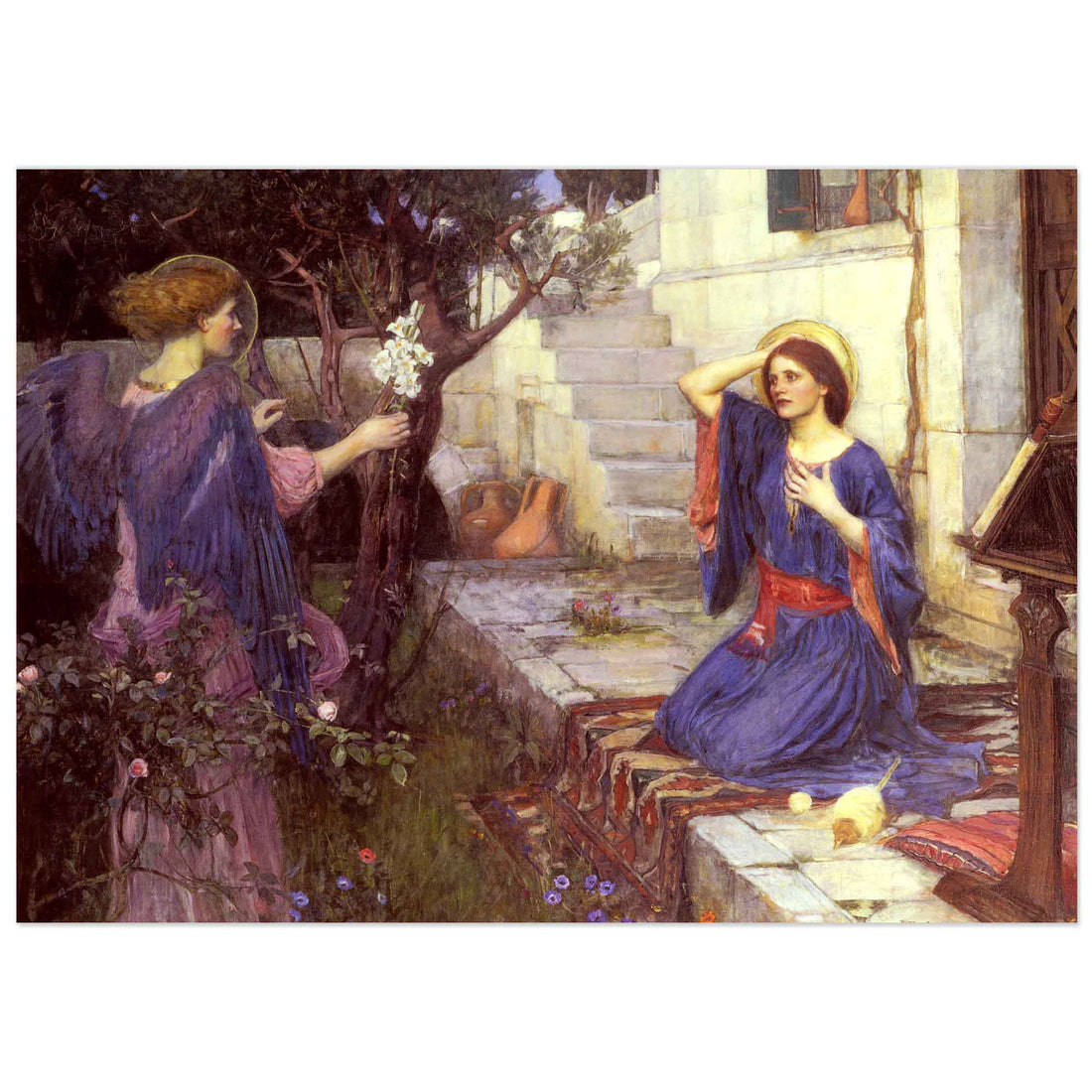
The Annunciation (1914)
A rare subject for Waterhouse, handled without heavy devotion: the Virgin, surprised in an enclosed garden, half turns away from the angel. Lilies, raking light and deep reds make it one of his finest late colour harmonies.
Also worth knowing: Ophelia, The Soul of the Rose, Circe
Waterhouse painted three versions of Ophelia (1889, 1894, 1910), each reading Hamlet's heroine differently. The Soul of the Rose (1908), inspired by Tennyson, shows a young woman breathing in a rose against a stone wall — probably his most intimate image. He also devoted three canvases to Circe, Homer's enchantress: Circe Offering the Cup to Ulysses (1891), Circe Invidiosa (1892, Art Gallery of South Australia) and The Sorceress (c. 1911–1915).
Put a Waterhouse on your wall
Every Wallango reproduction is printed from high-resolution source files on fine art paper with pigment inks, in sizes from 21 × 30 cm up to 70 × 100 cm.
- Matte fine art paper, faithful to the original colours
- Archival pigment inks
- Rigid packaging, protected shipping
- White border built in for standard framing
Where can you see original Waterhouse paintings?
- Tate Britain, London — The Lady of Shalott, The Magic Circle, Saint Eulalia, Consulting the Oracle
- Manchester Art Gallery — Hylas and the Nymphs
- Walker Art Gallery, Liverpool — Echo and Narcissus
- Lady Lever Art Gallery, Port Sunlight — several major Pre-Raphaelite canvases
- Art Gallery of South Australia, Adelaide — Circe Invidiosa
- Royal Academy of Arts, London — A Mermaid (diploma work)
A large share of his output remains in private collections: that is the case for Pandora, Boreas, Psyche Opening the Golden Box and The Soul of the Rose, which can only be seen in reproduction.
Which Waterhouse print should you choose?
His paintings work unusually well as wall art because they bring a figure and a story without flooding a room with strong colour.
- Living room, horizontal format: Hylas and the Nymphs or Echo and Narcissus, above a sofa or console.
- Bedroom, soft tones: Boreas, A Mermaid, The Soul of the Rose — sea greens, greys, faded pinks.
- Hallway, vertical impact: Pandora, Psyche, Lamia.
- Gallery wall: pair two or three Waterhouse prints with other Pre-Raphaelite prints or mythology prints, in matching frames.
For framing, light wood or a thin black profile suits almost every canvas; brass or gold pushes the Victorian character further.
A legacy of beauty and emotion
More than a century after his death, John William Waterhouse remains a bridge between myth and modern feeling. His women are not ornaments: they are readers, dreamers, figures thinking on the edge of a decision. Every canvas carries the Pre-Raphaelite ideal — that truth and beauty, once united, never fade.
At Wallango, we believe these visions deserve to live beyond museum walls, in homes that treat art as emotion, history and light.
FAQ – John William Waterhouse
What is John William Waterhouse famous for?
He is famous for paintings of female figures from Greek mythology, Arthurian legend and English literature, executed in a late Pre-Raphaelite style. The Lady of Shalott (1888) and Hylas and the Nymphs (1896) are among the most reproduced images in all of Victorian art.
Was Waterhouse part of the Pre-Raphaelite Brotherhood?
Not literally: the Brotherhood was founded in 1848, a year before he was born. Waterhouse adopted its themes and aesthetic from the 1880s onwards, which is why he is often called "the last Pre-Raphaelite". His style actually blends Pre-Raphaelitism, academic painting and Symbolism.
What is Waterhouse's most famous painting?
The Lady of Shalott (1888), held at Tate Britain in London. It illustrates Alfred Tennyson's poem and shows the heroine drifting towards Camelot at the moment she accepts her curse.
What does the painting Boreas mean?
Boreas is the Greek god of the north wind. The painting does not depict him directly: it shows a young woman caught in a spring gale. Waterhouse expresses human vulnerability before the forces of nature, and also a kind of beauty found inside that turbulence.
Who influenced John William Waterhouse?
First his painter parents and the Italy of his childhood, then the great Victorian academics Lawrence Alma-Tadema and Frederic Leighton, and finally the Pre-Raphaelites — Dante Gabriel Rossetti and Edward Burne-Jones in particular. His literary sources are Ovid, Homer, Shakespeare, Keats and Tennyson.
How many paintings did Waterhouse produce?
More than 200 finished works are attributed to him, mainly mythological, literary and historical subjects, alongside numerous studies and sketches.
Where are Waterhouse's paintings kept?
Mainly at Tate Britain, Manchester Art Gallery, the Walker Art Gallery in Liverpool, the Lady Lever Art Gallery and the Art Gallery of South Australia. A significant part of his work belongs to private collections and can only be seen in reproduction.
Where is John William Waterhouse buried?
At Kensal Green Cemetery in London, where he has rested since his death in February 1917.
Are Waterhouse's paintings in the public domain?
Yes. As the artist died in 1917, his works are in the public domain, so reproductions can be made and distributed freely.
How do you choose a good Waterhouse reproduction?
Check three things: the resolution of the source file (a museum-grade scan, not a compressed image), the paper (a heavy matte fine art stock renders half-tones better than glossy photo paper) and the inks (pigment rather than dye, for longevity). A generous size and a white border then make framing straightforward.
The Wallango Waterhouse collection
Museum-quality reproductions of The Lady of Shalott, Hylas and the Nymphs, Pandora, A Mermaid, Echo and Narcissus and more.