Kawase Hasui — A Master of the Shin Hanga Movement
At a time when Japan was rapidly modernising, Hasui chose to look inward — to the rural villages, coastal paths, and ancient architecture that defined a country in transition. Trained under the painter Kaburagi Kiyokata and later championed by publisher Watanabe Shōzaburō, he produced over 600 woodblock prints between 1918 and 1957, each one a meditation on light, atmosphere, and the passage of time.
What sets Hasui apart from his contemporaries is his extraordinary sensitivity to weather and season. Rain-drenched stone lanterns, moonlit temples, snow-blanketed courtyards — his compositions do not merely depict a place; they transport the viewer into it. His work blends the formal rigour of traditional Japanese woodblock techniques with the observational naturalism of Western-influenced realism, creating a visual language entirely his own.
Today, his prints are held in the permanent collections of the Smithsonian, the British Museum, and numerous institutions across Japan. For collectors and interior designers alike, a Kawase Hasui print represents not only artistic elegance but a tangible connection to one of the defining cultural movements of twentieth-century Japan.
Iconic Series: Souvenirs of Travel and Twenty Views of Tokyo
Hasui's two most celebrated series stand as pillars of the Shin Hanga movement and among the rarest Shin Hanga works sought by serious collectors today.
Souvenirs of Travel (Tabi miyage), begun in 1919, documents his journeys across the Japanese archipelago — from the fishing villages of Tohoku to the hot spring towns of Kyushu. Each print captures a specific moment and location with near-documentary precision, yet filtered entirely through Hasui's lyrical sensibility.
Twenty Views of Tokyo (Tokyo niju-kei) charts a city undergoing radical transformation. Several of the most celebrated prints in this series — including architectural views of Shiba Zōjōji and scenes from Yanaka — were produced before the Great Kanto Earthquake of 1923 destroyed much of what he had depicted. These pre-earthquake designs carry a particular historical resonance, preserving streetscapes and cityscapes that no longer exist.
Pre-earthquake designs and rare compositions
Among the most prized works in any Kawase Hasui collection are the prints made before September 1923. The earthquake and subsequent fires erased entire districts of Tokyo, rendering Hasui's records of those lost neighbourhoods irreplaceable as both art historical documents and as objects of cultural significance. For contemporary collectors, these compositions represent the intersection of artistic beauty and historical depth — a combination that explains their enduring appeal.
The Art of Light, Natural Landscapes, and Seasonal Atmosphere
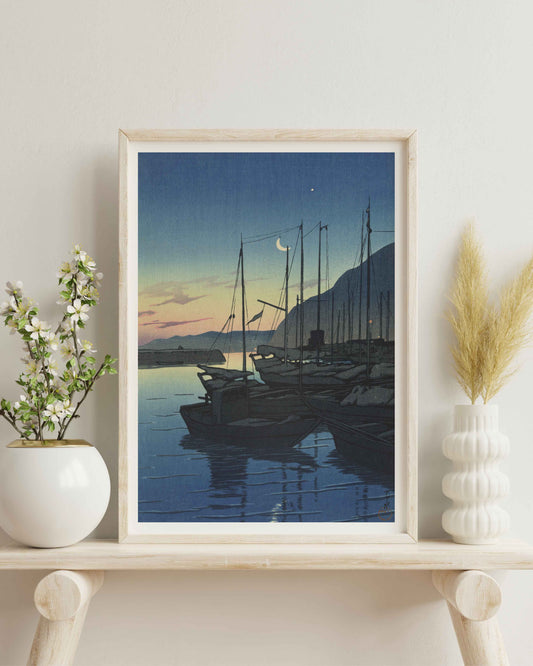
Hasui is often called a master of light — and with good reason. His prints pursue the precise quality of illumination at a given hour: the blue-grey of early morning on a mountain path, the amber warmth of a paper lantern reflected in wet cobblestones, the cold silver of a full moon over still water.
His treatment of natural landscapes is equally distinctive. Where earlier ukiyo-e artists often favoured bold, graphic compositions, Hasui's scenes breathe. Forests recede into mist. Coastlines stretch toward the horizon. Snow falls with palpable weight. The seasonal views that appear throughout his work — cherry blossoms in spring, heavy summer rain, the blazing maples of autumn, deep winter silence — are not decorative backdrops but the true subject of the image.
This sensitivity to the natural world, combined with his meticulous craftsmanship and the detailed craftsmanship of his carvers and printers, gives each print a quality that rewards extended looking. There is always more to find.
Night Scenes and Moonlit Temples
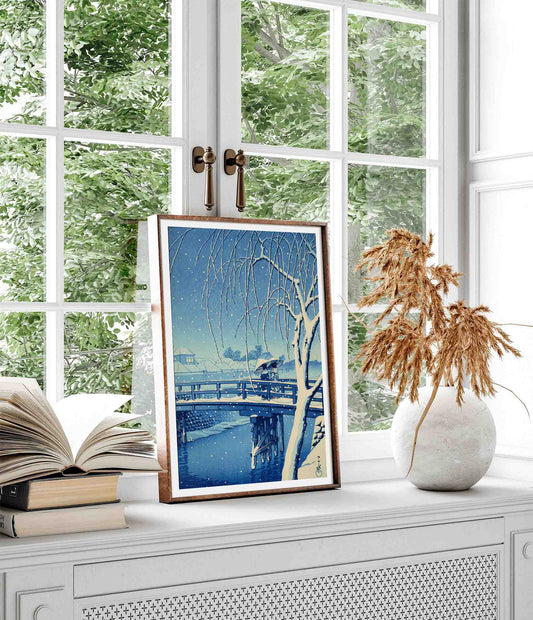
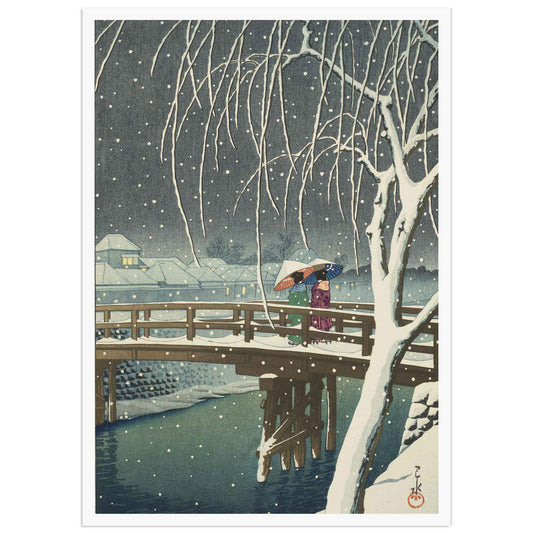
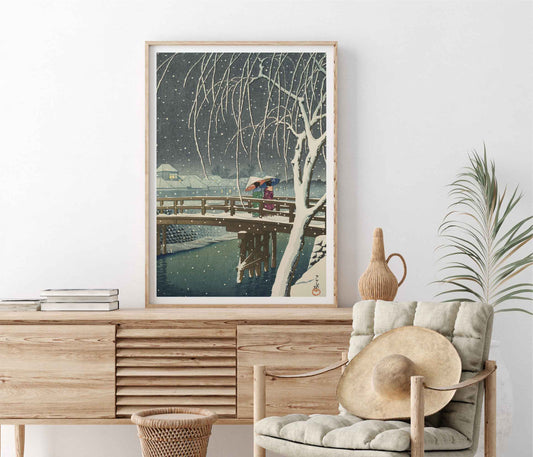
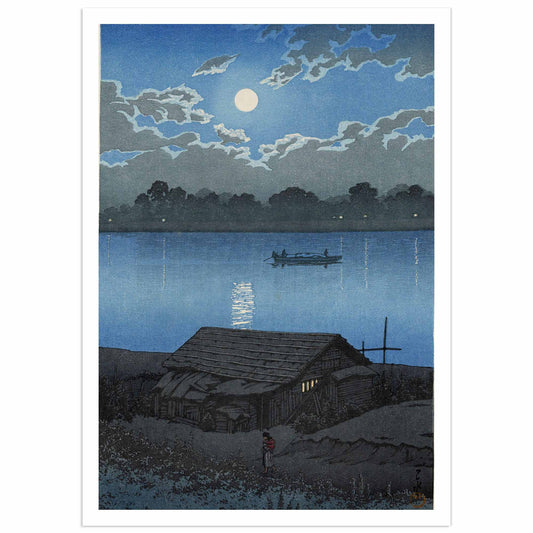
Hasui was a poet of the evening. Moonlight on a river, lanterns glowing through falling snow, the last blue light over a bridge at twilight: he often worked at the hour when colors fade and shapes soften. Prints such as Moon on the Arakawa River at Akabane, Kiyosu Bridge at Twilight and Evening Snow on the Edo River show how he turned darkness itself into color, with deep indigos, soft greys and a single warm light in a window.
Hasui's Favourite Themes
Snow
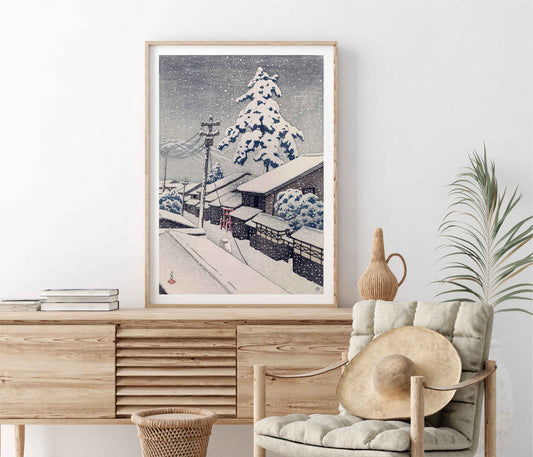
Snow at Tsukishima
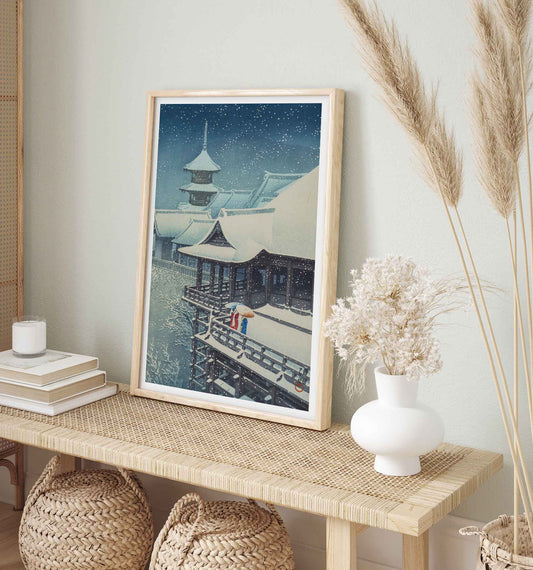
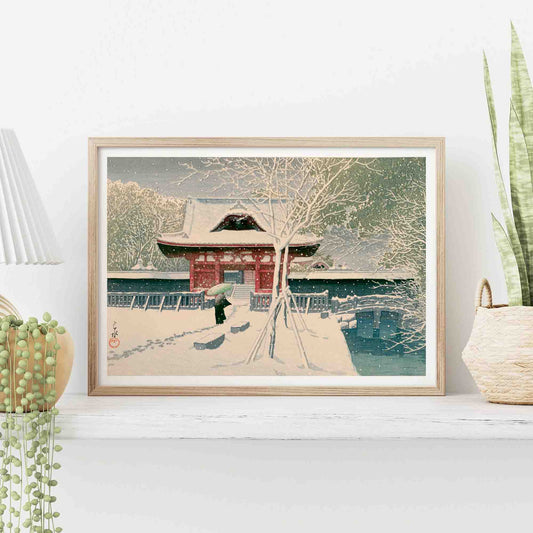
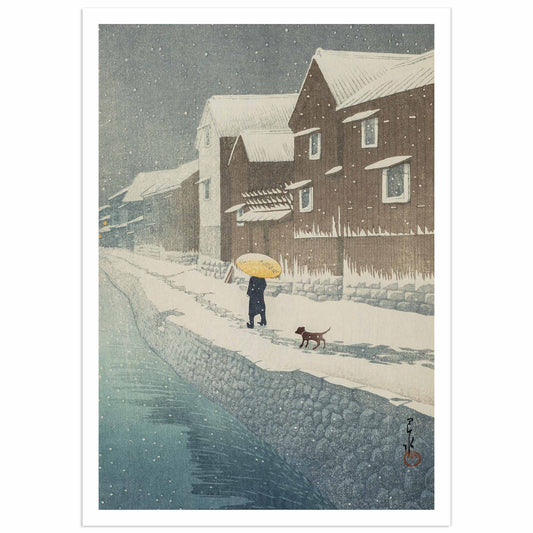
Snow scenes are among Hasui's most iconic works. They create a visual silence, a suspended atmosphere in which shapes simplify and light softens. Discover eleven of them in Kawase Hasui Snow Prints: 11 Winter Scenes of Japan.
Rain
Beach Shed at Himi, Etchū Province, from Souvenirs of Travel II
Rain lets Hasui explore movement, reflections and the fleeting moment. Human figures become secondary to the mood of the scene.
Night
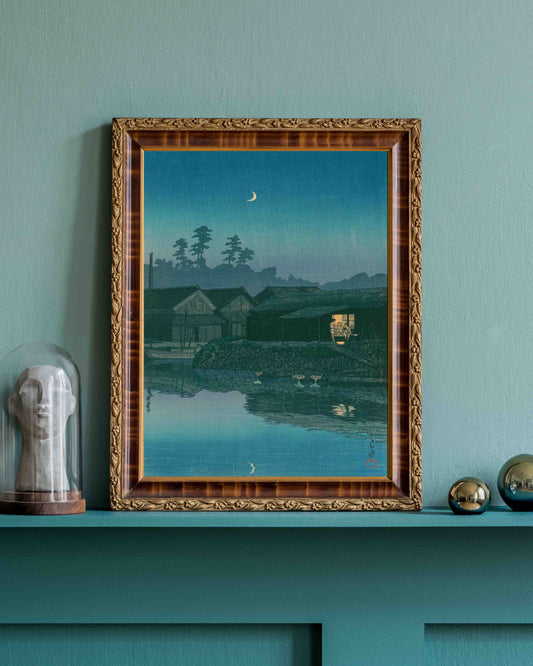
Gosaibori Canal, Niigata, from Souvenirs of Travel II
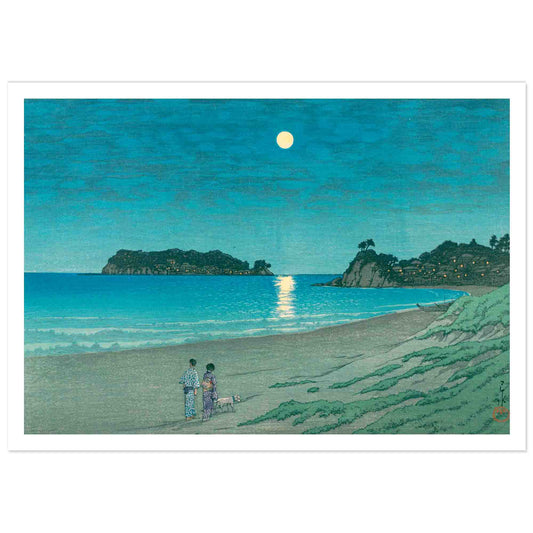
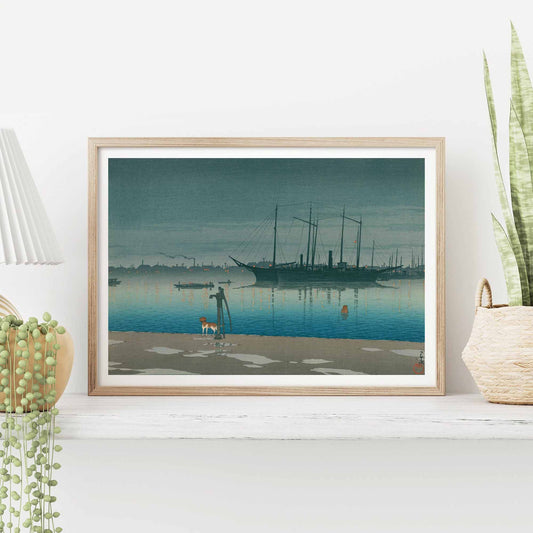
His night scenes reveal his mastery of light and contrast: deep indigo skies, lit windows, moonlight on water. They invite quiet contemplation.
Temples and Traditional Japan
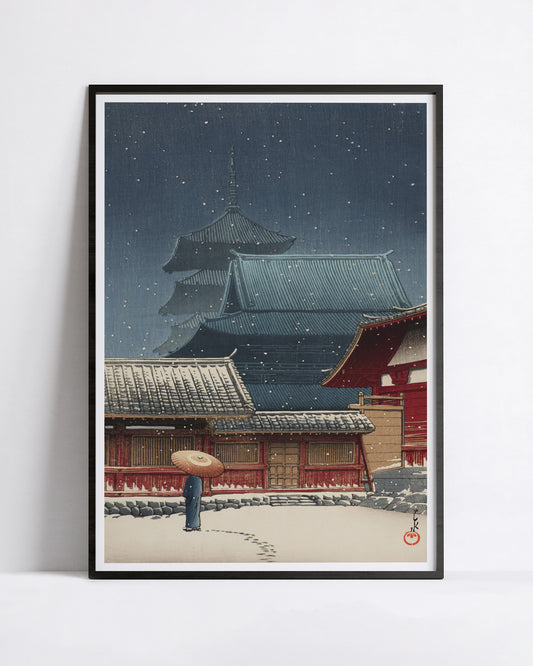
Tennō-ji, Osaka, from Souvenirs of Travel III
Hasui returned again and again to temples, shrines and old wooden architecture, painting a timeless Japan in which buildings and nature are in harmony.
Resilience and a Final Masterpiece
The war years brought new hardship: towards the end of the Second World War, Hasui left Tokyo and took refuge in Shiobara, in Tochigi Prefecture, where he had spent part of his childhood. His post-war work, created in his sixties and early seventies, shows no loss of vision.
His final print, Hiraizumi Konjikidō (the Golden Hall of Chūson-ji at Hiraizumi), is a snow scene. He began the original painting in 1955 and completed the design shortly before his death in 1957; the print was published posthumously. By any measure, it is a masterpiece.
Four Prints from the Collection
Osaka Tennoji — Tenno-ji Temple in Osaka
Buy Kawase Hasui's Osaka Tennoji (Tenno-ji Temple in Osaka) print
One of the most venerable temples in Japan, Tenno-ji is rendered here with characteristic restraint. Hasui balances the weight of the temple's architectural forms against the openness of the surrounding space, achieving a composition that feels both monumental and intimate. The moody light that falls across the courtyard is among the finest examples of his treatment of architectural prints.
Konjikidō in the Snow, Hiraizumi
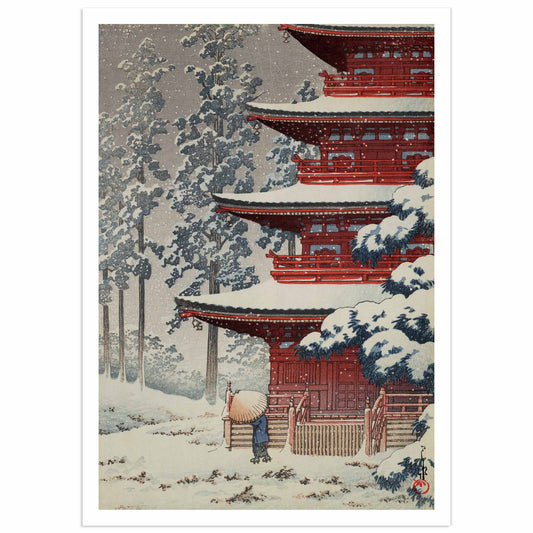
Buy Kawase Hasui's Konjikidō in the Snow, Hiraizumi print
The Golden Hall of Chūson-ji, built in 1124 and one of the few structures to survive the destruction of the Hiraizumi kingdom, is here clothed in deep winter snow. Hasui's palette is almost monochromatic — whites, pale greys, the faintest trace of gold — and the silence that pervades the image is absolute. This is among his most reproduced compositions, and among the most beloved in Japanese art history.
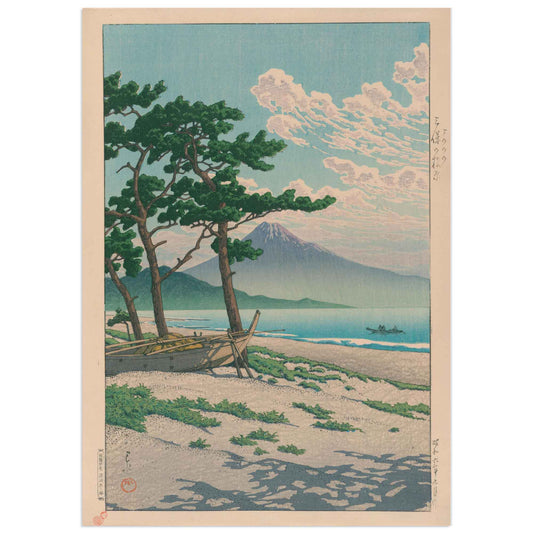
Pine Beach at Miho — Miho no Matsubara
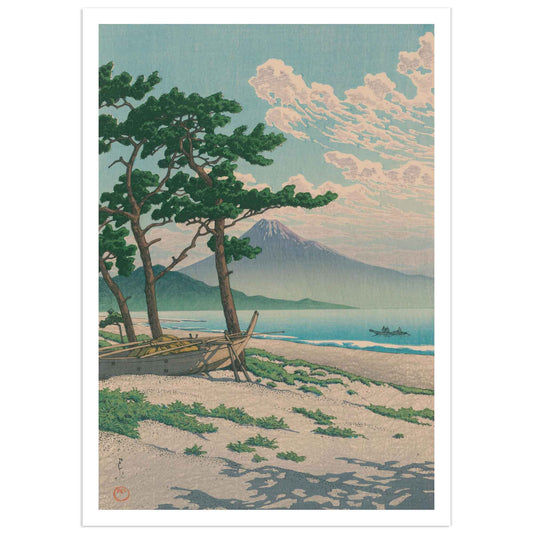
Buy Kawase Hasui's Pine Beach at Miho print
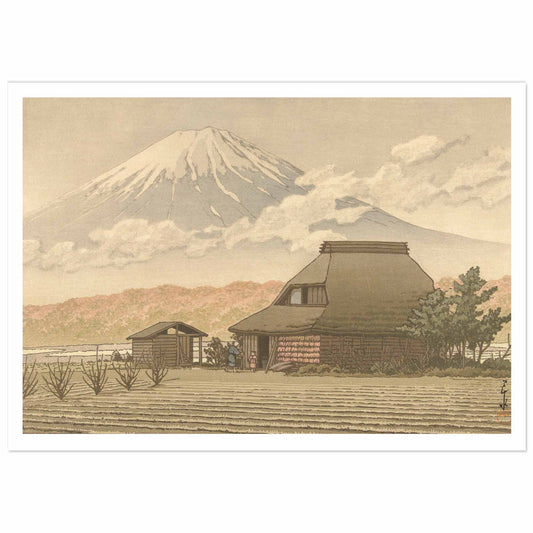
Miho no Matsubara, the pine-forested spit of land on Suruga Bay with Mount Fuji rising behind it, has been a subject of Japanese art and poetry for over a thousand years. Hasui's version is a study in contrasts: the fluid, restless ocean against the solid, ancient pines; the transience of waves against the permanence of the mountain. The vibrant color reproduction achieves a luminosity that brings this coastal beauty to life.
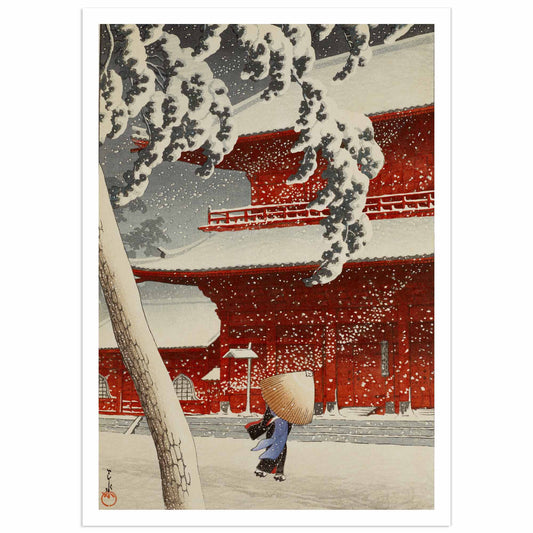
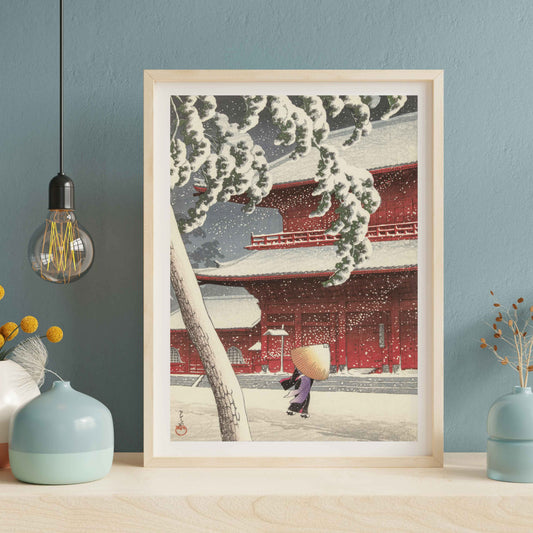
The Temple Zōjōji in Shiba
Buy Kawase Hasui's Temple Zōjōji in Shiba print
Zōjōji, the great Jōdo Buddhist temple in the Shiba district of Tokyo, appears in several of Hasui's Tokyo prints — none more celebrated than this one. The temple gate is illuminated against a darkening sky with a sensitivity to atmosphere that exemplifies Hasui's mature style. As a pre-earthquake design depicting traditional Japanese scenes that have since changed beyond recognition, it carries an additional layer of historical poignancy.
High-Quality Kawase Hasui prints for Collectors
Original Kawase Hasui prints, particularly those from the pre-earthquake period or from key series such as Souvenirs of Travel, now command significant prices at specialist auction houses and are held primarily in institutional collections. High-quality reproductions make this artistic legacy accessible without compromise on visual fidelity.
At Wallango, every print in the collection is produced at 300 dpi on premium 230 gsm archival paper, using a colour reproduction process calibrated to Hasui's original palette — his signature muted greens, the warm ochres of lantern light, the cold blues of winter nights. The result is a vibrant color reproduction that honours both the visual beauty and the cultural significance of each work.
All prints are available in standard formats (A3, A2, and others) compatible with commercial frames, and are printed in Europe by fine art reproduction specialists under rigorous quality control.
Kawase Hasui Prints in Your Home
Hasui's calm, atmospheric landscapes are among the easiest Japanese prints to live with. Snow scenes and night views bring a quiet, cocooning mood to a bedroom or reading corner; temples and coastal views add depth to a living room or hallway. They suit Japandi, minimalist and Scandinavian interiors alike. Choose a natural oak or black frame with a wide white mat for a gallery look, or group three prints from the same season for a simple, harmonious wall.
Frequently Asked Questions
Who was Kawase Hasui?
Kawase Hasui (1883–1957) was the leading printmaker of the Shin Hanga movement. Renowned for his poetic treatment of natural landscapes, seasonal atmosphere, and Japanese cultural scenes, he produced over 600 woodblock prints across nearly four decades. His work is held in major museum collections worldwide, including the Smithsonian Institution in Washington D.C.
What is the Shin Hanga movement?
Shin Hanga, meaning "new prints," was a Japanese art movement of the early twentieth century that sought to revitalise the traditional woodblock print by combining classical Japanese techniques with Western-influenced naturalism. Publishers — most notably Watanabe Shōzaburō — worked with artists, carvers, and printers collaboratively, producing works of exceptional technical refinement. Hasui was its most prolific and celebrated landscape artist.
How many prints did Kawase Hasui produce?
Hasui created over 600 woodblock prints between 1918 and 1957. The majority were published by Watanabe Shōzaburō, though he also worked with other publishers throughout his career.
What are Kawase Hasui's most famous works?
Among his most celebrated compositions are Snow at Zōjōji Temple, Evening at Yanaka, Moonlit Night at Miyajima, and several prints from the Souvenirs of Travel series. His pre-earthquake designs depicting Tokyo before 1923 are particularly valued for their historical depth and artistic elegance.
Are the prints sold at Wallango original Kawase Hasui works?
No. These are high-quality reproductions of Kawase Hasui's woodblock prints, produced using modern printing techniques on museum-grade archival paper. They are not original editions and are priced accordingly.
What print quality should I expect?
All reproductions are printed at 300 dpi on 230 gsm archival paper. The colour reproduction process is calibrated to the original works, preserving Hasui's characteristic tonal contrasts, seasonal colour palettes, and the subtle interplay of light and shadow that defines his style.
What sizes are available?
Most prints are available in A3, A2, and other standard formats. Exact dimensions are listed on each product page. All formats are compatible with standard commercial frames.
Where are the posters printed?
All prints are produced in Europe by specialist fine art reproduction studios, ensuring consistent quality and reliable delivery times.
Why choose a reproduction over an original print?
Original Kawase Hasui prints — particularly the rarest Shin Hanga editions and pre-earthquake designs — are rare, expensive, and frequently unavailable on the open market. A carefully produced reproduction allows you to engage with the artistic elegance and cultural significance of Hasui's work in your own home, at a fraction of the cost, without any compromise on the visual experience.
What is the difference between ukiyo-e and shin-hanga?
Ukiyo-e ("pictures of the floating world") flourished in the Edo period (17th–19th century) with artists like Hokusai and Hiroshige. Shin-hanga ("new prints") revived the woodblock tradition in the 20th century, adding Western realism, light and atmosphere. Kawase Hasui was its leading landscape artist.
Which Kawase Hasui prints are the rarest?
Prints made before the Great Kantō Earthquake of September 1923, whose woodblocks were destroyed in the fire at his publisher Watanabe's workshop. Early lifetime impressions of his later designs are also highly prized by collectors.