Katsushika Hokusai — The Old Man Mad About Drawing (1760–1849)
The Man Who Changed Art Without Knowing It
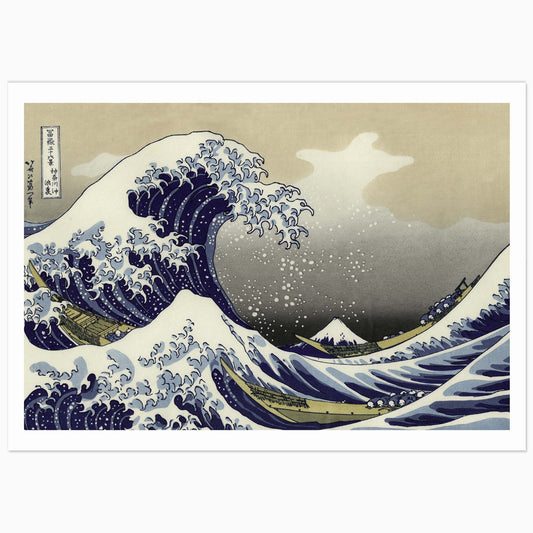
In the winter of 1831, a Japanese print publisher issued the first instalment of a new series of landscapes — thirty-six views of a mountain most Japanese people had never climbed but all of them knew. The fifth image in the series depicted two fishing boats riding enormous waves in the waters off Kanagawa, with the white cone of Mount Fuji visible in the far distance, small and serene beneath the curl of the breaking water.

The man who drew it was 71 years old. He had been making art for over fifty years, had used more than thirty different names, had changed styles so many times his own contemporaries struggled to keep track, and had gone bankrupt twice. He would live another eighteen years, producing work until the day he died, and would never quite understand why this particular print, among the 30,000 images he made across his lifetime, was the one that would one day be reproduced on T-shirts and coffee cups on every continent on earth.
Katsushika Hokusai is the most internationally recognised Japanese artist in history. His influence on Western art — on the Impressionists, on Art Nouveau, on graphic design, on the very idea of what a wave or a mountain or a flower could look like in two dimensions — is incalculable. And yet he thought of himself, until his death at 89, as a student. 'If I had another five years,' he reportedly said on his deathbed, 'I could have become a real painter.'
Self-portrait of Katsushika Hokusai as an old man
Fifty Years of Reinvention
Born in Edo (now Tokyo) in 1760, Hokusai was apprenticed to a mirror-polisher and then a wood-engraver before entering, at the age of 18, the studio of Katsukawa Shunsho — one of the leading ukiyo-e artists of the day. He excelled from the start, producing prints of kabuki actors with the school's characteristic bold outlines and flat colour. But he chafed against the school's conventions, and after Shunsho's death he began the long series of stylistic transformations that would define his career.
He studied Chinese and European painting techniques. He produced erotica, ghost stories, flower albums, sketchbooks. He published fifteen volumes of the Manga — not comics in the modern sense, but encyclopedic collections of sketches covering everything from birds and fish to wrestlers, demons, waves and mountains. The Manga became a technical reference for generations of Japanese artists and a revelation for European designers who encountered them in the 1860s.
The Great Wave off Kanagawa was produced when Hokusai was in his early seventies, at the peak of his technical powers. The Thirty-Six Views of Mount Fuji that contained it was followed, years later, by One Hundred Views of Mount Fuji — a privately published three-volume set that many scholars consider his greatest achievement. At 80, he signed his work Gakyo Rojin Manji: 'The Old Man Mad About Drawing'.
The Great Wave: What Makes It
The print that made Hokusai's name worldwide is formally titled 'Under the Wave off Kanagawa'. It is technically a landscape — Fuji is the subject of the series — but it functions as something more: a meditation on scale, on the relationship between human endeavour and natural force, on the moment between destruction and survival.
The composition is constructed with geometric precision. The great wave on the left mirrors the shape of Mount Fuji on the right; the hollow in the breaking crest frames the mountain perfectly. The boats are tiny, the rowers bent low, but their posture is active, not passive — they are riding the wave, not being crushed by it. The blue Hokusai used, Prussian blue, was a recently introduced pigment, vivid and lightfast in a way that traditional Japanese blues were not. It gave the print a coldness and clarity that older ukiyo-e compositions could not achieve.
Monet owned several Hokusai prints. Van Gogh copied the Great Wave in a letter to his brother. Debussy kept a reproduction on his piano while composing La Mer.
Collections and Legacy
Hokusai's work is held in virtually every major print collection in the world, including the British Museum (London), the Metropolitan Museum of Art (New York), the Art Institute of Chicago, the Bibliothèque nationale de France (Paris), and the Tokyo National Museum. In 2021, the Hokusai Museum in Sumida, Tokyo — the district where he was born — opened a permanent gallery dedicated to his work.
He used over 30 names in his lifetime, the last being Gakyo Rojin Manji, meaning 'Old Man Mad About Drawing, at Eighty'. He reportedly said he wished to live to 110 so he could finally produce a single brushstroke that was truly alive. He died at 89, still drawing.
Discover Hokusai at Wallango
Wallango offers museum-quality reproductions printed on thick archival paper with exceptional colour fidelity. Ready to frame, shipped in a rigid protective tube.
-
The Great Wave off Kanagawa Poster – Hokusai
Regular price From $37.00Regular priceUnit price per -
Mishima Pass in Kai Province – Katsushika Hokusai
Regular price From $37.00Regular priceUnit price per -
Thunderstorm Beneath the Summit – Katsushika Hokusai
Regular price From $37.00Regular priceUnit price per -
Umezawa Manor in Sagami Province – Katsushika Hokusai
Regular price From $44.00Regular priceUnit price per