Kawanabe Kyosai Prints – The Demon of Painting
Kawanabe Kyōsai (1831–1889) was the most irreverent, prolific, and formally brilliant artist of Meiji-era Japan — and the one who least resembled anyone else. Nicknamed Gaki Kyōsai — the Demon of Painting — he trained under ukiyo-e master Kuniyoshi and at the elite Kano school, then spent the rest of his life doing exactly what both schools had taught him not to do. He was arrested for his political caricatures, reportedly drank three bottles of sake by noon, and produced thousands of paintings, prints, and sketches that mixed Buddhist tradition, supernatural folklore, social satire, and dark comedy into something no one had attempted before.
His work directly influenced the birth of manga. His yokai imagery defined a visual language still very much alive in Japanese popular culture today.
Frogs, Demons and the Animal World
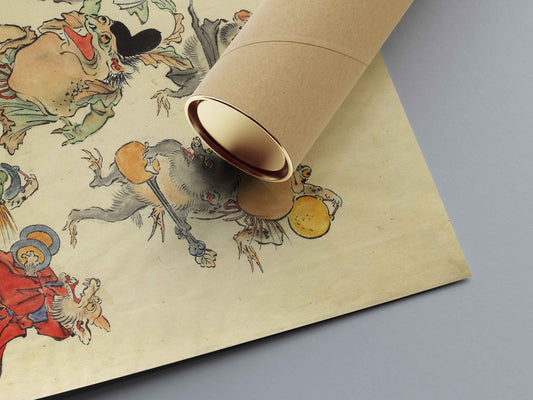
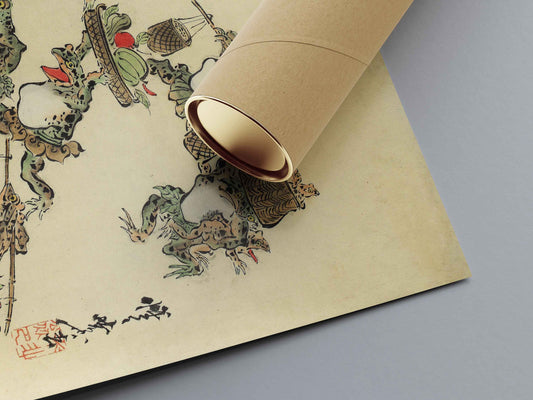
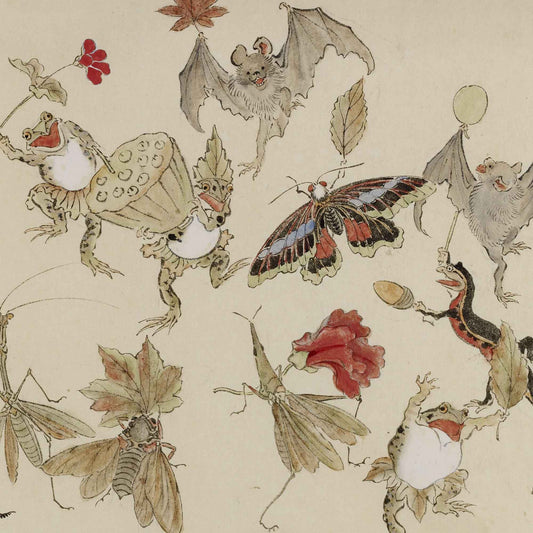
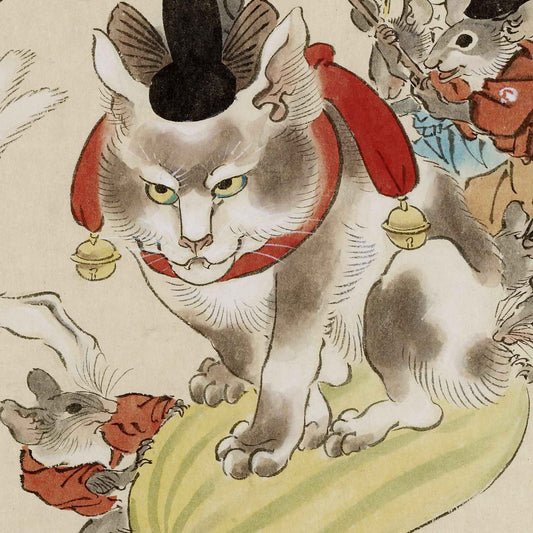
The frogs are the thing most people encounter first. Kyosai's frog processions — animals dressed as humans, conducting Shinto rituals, playing instruments, running with lanterns — are among the most joyful and subversive images in Japanese art. They work on two levels at once: genuine delight in the absurdity of the scene, and pointed commentary on the bureaucratic ceremonies of Meiji society. The same logic applies to his dancing animal compositions, his elephant studies, and his cat parades — everything is both exactly what it appears to be, and something else entirely.
Yokai, One Hundred Demons and the Supernatural
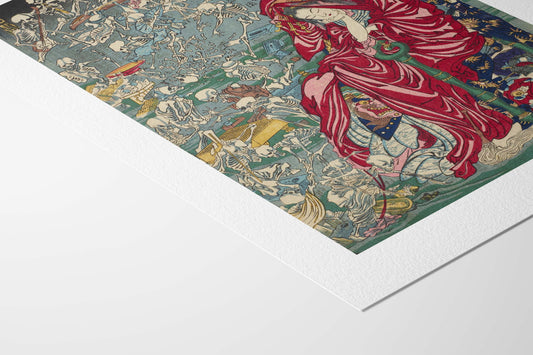
Kyosai's Pictures of One Hundred Demons (Kyōsai hyakki gadan, 1890) is the definitive expression of his supernatural imagination — an entire bestiary of yokai, oni, and spectral figures unleashed in an unbridled panorama of black humour and precise brushwork. Tengu, ghosts, dancing skeletons, fox spirits, the King of Hell: Kyosai populated Japan's supernatural world with the same energy and satirical intent he brought to his political caricatures.
Crows — Kyosai's Signature Subject
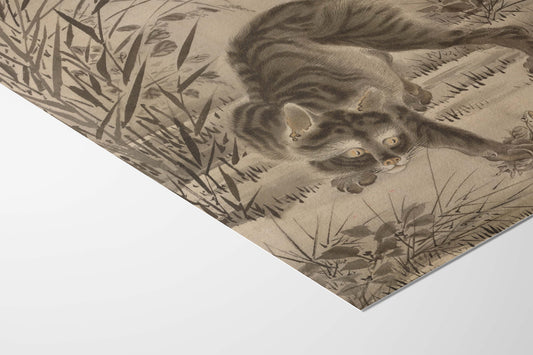
Kyosai's crow paintings are among his most technically extraordinary works. Where his animal satires are expansive and chaotic, the crow compositions are disciplined and still — powerful ink forms against mist, achieving in a few brushstrokes the kind of chiaroscuro effect that took Western painters many layers to approach. His crow won first prize at the Tokyo Domestic Industrial Exposition in 1881.
Museum-Quality Kyosai Prints, Ready to Frame
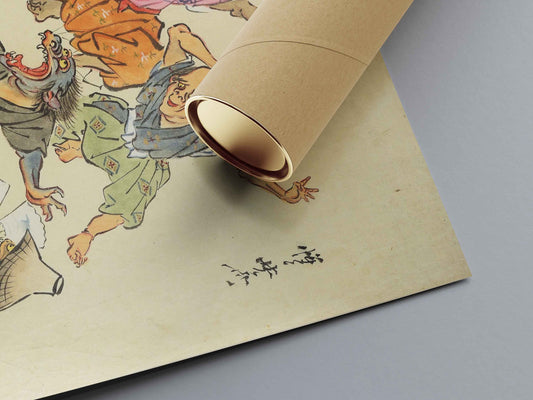
All prints in this collection are reproduced on thick archival paper, preserving the energy of Kyosai's brushwork and the depth of his ink gradations. Shipped in a rigid protective tube.
Mini FAQ
What is Kawanabe Kyosai famous for?
Kawanabe Kyosai is best known for his supernatural imagery — particularly his Pictures of One Hundred Demons (1890) — and his satirical animal compositions featuring frogs, demons, and crows. He is also regarded as a pioneer of manga and one of the greatest caricaturists of 19th-century Japan.
What does "yokai" mean in Kyosai's prints?
Yōkai are supernatural creatures from Japanese folklore — demons, ghosts, spirits, and shape-shifters. Kyosai made them the central subject of some of his most celebrated works, blending traditional iconography with political and social satire.
Where can I see Kyosai's original works?
The Kawanabe Kyosai Memorial Museum in Warabi, Japan holds the largest collection. Major Western institutions with significant holdings include the British Museum, the Metropolitan Museum of Art, and the Rijksmuseum in Amsterdam.