

Japanese Yokai: The Complete Guide to Demons, Spirits & Supernatural Creatures
In the shadowy corners of Japanese folklore lurks a world of thousands of supernatural beings: shapeshifting foxes, living umbrellas, invisible walls that block the road and creatures that devour nightmares. These are the yōkai (妖怪), creatures that have haunted, entertained and inspired Japan for more than a thousand years.

Hyakki yagyō (the night parade of one hundred demons), by Kawanabe Kyosai.
Table of contents
- What are yōkai?
- History: from ancient fear to pop culture
- Categories of yōkai
- The Big Three evil yōkai
- Oni: Japan’s iconic demons
- Kitsune: the fox spirits
- Tengu: guardians of the mountains
- Kappa: the river tricksters
- Tsukumogami: when objects come alive
- Yūrei: Japanese ghosts
- More famous yōkai: bakeneko, yuki-onna, gashadokuro…
- Yōkai in modern culture
- How to protect yourself from yōkai
- List of yōkai from A to Z
- Why yōkai still matter
- Further reading
What Are Yōkai? Understanding Japan’s Supernatural Beings
Defining the indefinable
The word yōkai (妖怪) combines two characters:
- 妖 (yō): bewitching, mysterious, calamity
- 怪 (kai): strange, mystery, apparition
Yōkai are not simply “Japanese demons”, as the word is often mistranslated. They are the embodiment of unexplained moments: the feeling of footsteps behind you when no one is there, objects that vanish and reappear, shadows that seem to move on their own, nature behaving strangely. Yōkai are the supernatural explanation for the inexplicable.

Yōkai, by Kawanabe Kyosai.
Yōkai and other supernatural terms
Japanese folklore uses several overlapping terms:
| Term | Meaning | Key point |
|---|---|---|
| Yōkai (妖怪) | The broadest term for supernatural creatures | Malevolent, benevolent or neutral: not all are evil. Covers monsters, spirits and transformed objects. |
| Obake (お化け) / Bakemono (化け物) | “Thing that changes” | Shapeshifters, such as the kitsune (fox) or the tanuki (raccoon dog). |
| Yūrei (幽霊) | Ghosts of human beings | Spirits held on earth by a strong emotion (revenge, love, regret). Unlike yōkai, they were once human. |
| Oni (鬼) | Demons, ogres | Powerful and often malevolent yōkai, with horns, fangs and a club. |
| Mononoke (物の怪) | Possessing spirit | A spirit able to possess people, made famous by Studio Ghibli’s Princess Mononoke. |
| Ayakashi (妖) | Supernatural phenomena | A regional term, mainly from western Japan, often linked to the sea. |
History: From Ancient Fear to Pop Culture Icons
Origins: the Heian period (794-1185)
The world of yōkai takes shape in the Heian period, when nobles and commoners alike lived in fear of:
- the vengeful spirits of the dead;
- kami (gods, spirits) angered by human behaviour;
- mysterious diseases attributed to supernatural causes;
- natural disasters seen as punishments.
The earliest texts already bear witness to them. The Kojiki (712) and the Nihon shoki (720), Japan’s oldest chronicles, mention fearsome deities and supernatural beings, including the first oni. Around 1010, The Tale of Genji features mononoke, spirits that possess some of its characters.

Silla lion dance (Shiragi koma), from the Shinzei-kogakuzu scroll (信西古楽図). 18th-century copy of a Heian-period painting.
Though not a yōkai as such, this ritual dance from Korea shows the roots of the Japanese supernatural imagination, where imported guardian spirits such as the komainu bridge Korean, Buddhist and Shintō traditions.
The Edo period (1603-1868): the golden age of yōkai

The kami Inari appearing to a man, by Utagawa Kuniyoshi.
In the Edo period, yōkai move from terror to entertainment. Several factors explain the shift:
- Peace: 250 years without major war gave people time for leisure.
- Urbanisation: Edo (today’s Tokyo), Kyoto and Osaka grew, and audiences wanted shows and stories.
- Printing: woodblock printing made illustrated books cheap.
- Literacy: more and more readers devoured illustrated stories.
Three milestones mark the period:
- 1712, the Wakan sansai zue (和漢三才図会): this illustrated encyclopedia lists fantastic creatures alongside real animals, with a lasting influence on how they were depicted.
- 1776, the Gazu hyakki yagyō (画図百鬼夜行), “The Illustrated Night Parade of One Hundred Demons”: the artist Toriyama Sekien (1712-1788) publishes the most influential bestiary in history. Many of the yōkai we know today were codified, or even invented, by him.
- The 1830s-1860s, the rise of ukiyo-e: Utagawa Kuniyoshi creates spectacular yōkai prints, Katsushika Hokusai illustrates ghost stories, and yōkai become true popular icons.
The Meiji era (1868-1912): decline
Japan’s modernisation hits the yōkai hard:
- Western science discredits supernatural explanations;
- electric lighting replaces lanterns, and mysterious shadows become rarer;
- railways and the telegraph separate “civilised” Japan from a past seen as superstitious;
- the authorities discourage folklore as backward.
Paradoxically, this is also when the philosopher Inoue Enryō founds “yōkaigaku”, the study of yōkai, in order to prove they were illusions. By 1900, yōkai seem doomed to disappear.
The Shōwa era (1926-1989): revival
In the 1960s, manga artist Shigeru Mizuki (1922-2015) almost single-handedly revives the world of yōkai with GeGeGe no Kitarō. He makes them likeable and part of everyday life, invents new creatures now seen as “traditional”, and sparks a national craze. In the same period, the Yōkai Monsters film series brings the classic creatures to the screen and becomes a cult favourite.
The Heisei and Reiwa eras (since 1989): global conquest
- Video games: Pokémon (1996) draws on folklore, and Yo-kai Watch (2013) makes catching yōkai its very premise.
- Animation: Spirited Away (2001) introduces yōkai to the whole world, followed by Mushishi (2005) and Natsume’s Book of Friends (2008).
- Social media: yōkai appear on Instagram and TikTok, in “dark academia” aesthetics and in tattoo studios worldwide.
Categories of Yōkai: A Taxonomic Approach
Folklorists have tried to sort yōkai into broad families. No classification is authoritative, but this one helps find your way.
1. Animal yōkai (dōbutsu-kei)
Inspired by real or mythical animals: the kitsune (fox), the tanuki (raccoon dog), the bakeneko (cat), the tengu (part man, part bird) or the kappa (a shelled water creature).

Kappa drawings from the Suiko jūni-hin no zu (水虎十二品之図, “Illustrated Guide to 12 Types of Kappa”), mid-19th century.
This guide presents kappa with the precision of a naturalist’s study. Edo artists often approached mythical creatures like biologists facing real animals, cataloguing their anatomy, habits and habitat. This blend of folklore and observation gives animal yōkai a surprisingly scientific realism.
2. Object yōkai (tsukumogami)
Everyday objects that come to life after a century of existence: the kasa-obake (umbrella), the chōchin-obake (paper lantern), the biwa-bokuboku (lute) or the kameosa (sake jar).

Print A New Collection of Tsukumogami (新板化物つくし), 1860.
3. Humanoid yōkai
More or less human in appearance: the oni (demons, ogres), the rokurokubi (woman with a stretching neck), the futakuchi-onna (two-mouthed woman) or the kuchisake-onna (slit-mouthed woman).

Kūkai (Kōbō Daishi) practising tantra, with a demon (oni) and a wolf, by Katsushika Hokusai.
4. Nature yōkai
Linked to natural phenomena: the kaze-no-kami (wind spirits), the umibōzu (sea monk), the yuki-onna (snow woman) or the hinoenma (fire yōkai).
5. Phenomenon yōkai
Manifestations of unexplained sensations or events: the makuragaeshi (pillow flipper), the nurikabe (invisible wall) or the betobeto-san (footsteps that follow you).

Nurikabe (ぬりかべ), from the Bakemono no e (化物之繪), around 1700.
The Big Three: The Most Feared Yōkai in History
Japanese tradition singles out the three great evil yōkai (日本三大悪妖怪): a demon king, a nine-tailed fox and an emperor turned vengeful spirit.
1. Shuten-dōji (酒呑童子), the sake-drinking demon

Shuten-dōji, king of the oni. Woodblock print by Tsukioka Yoshitoshi, 1887.
Type: oni (demon king) · Period: Heian (10th-11th century) · Place: Mount Ōe (大江山), near Kyoto
The legend: during the reign of Emperor Ichijō (986-1011), young noblewomen disappear in Kyoto. The famous diviner Abe no Seimei identifies the culprit: Shuten-dōji, chief of the oni of Mount Ōe, who abducts them to devour them. An insatiable giant with a great love of sake, he can also take the form of a child or a handsome young man, as his name suggests (dōji means “child”).
His defeat: the warrior Minamoto no Raikō (948-1021) and his four companions infiltrate his fortress disguised as mountain ascetics (yamabushi). They offer him poisoned sake, the jinben kidoku-shu (神便鬼毒酒, “divine sake, poison for demons”), then behead him in his sleep. Even severed, the demon’s head flies up and tries to bite Raikō: only his helmet saves him.
2. Tamamo-no-Mae (玉藻前), the nine-tailed fox

Tamamo-no-Mae in human form. Woodblock print by Tsukioka Yoshitoshi.
Type: kitsune (fox) · Period: 12th century · Place: the imperial court, Kyoto
The legend: a woman of extraordinary beauty and learning, Tamamo-no-Mae, becomes the favourite of the retired emperor Toba. But he mysteriously falls ill. The diviner Abe no Yasuchika unmasks the courtesan: she is a nine-tailed fox (kyūbi no kitsune, 九尾の狐) draining the emperor’s life force.
According to legend, the same spirit had already brought down kingdoms across the continent: it was said to have been Daji, the wicked consort who caused the fall of the Shang dynasty in China, then Lady Kayō, who nearly ruined a kingdom of ancient India.
Her defeat: exposed, Tamamo-no-Mae flees to the plain of Nasu. The warriors Miura-no-suke and Kazusa-no-suke hunt her down and kill her. She then turns into the Sesshō-seki (殺生石, “killing stone”), a rock giving off deadly gas, until the Buddhist monk Gennō exorcises it at the end of the 14th century.
3. Emperor Sutoku (崇徳天皇), the vengeful spirit

Emperor Sutoku in exile. Woodblock print by Tsukioka Yoshitoshi, 1885.
Type: onryō (vengeful spirit) · Died: 1164 · Place: Sanuki province (today’s Kagawa prefecture, on the island of Shikoku)
The story: Emperor Sutoku reigns from 1123 to 1142, before being forced to abdicate in favour of his half-brother. In 1156, during the Hōgen rebellion, he tries to regain power, fails, and is exiled to Sanuki province, where he dies in 1164.
The transformation: according to legend, Sutoku spends his exile copying sutras in his own blood, to offer them to the temples of Kyoto as a sign of repentance. Fearing a curse, the court refuses them. Mad with rage, he bites his tongue, writes a curse in his blood and swears to become a great demon (大天狗, daitengu) and plunge Japan into chaos. The Genpei War (1180-1185), natural disasters and centuries of political turmoil were later blamed on him.
Appeasement: it was not until 1868, 704 years after his death, that Emperor Meiji brought his spirit back to Kyoto and dedicated a shrine to him, Shiramine-jingū, to appease it.
Oni: Japan’s Iconic Demons

Sessen Dōji offering his life to an oni, by Soga Shōhaku, 1764.
What are oni?
Oni (鬼) are the most recognisable yōkai, translated as demons, ogres or devils. Their appearance is codified:
- a massive, very muscular humanoid body, much taller than a man;
- coloured skin: most often red, but also blue, green, black or yellow;
- horns, usually two, sometimes one or three, and fangs;
- wild hair and a tiger-skin loincloth;
- a studded iron club, the kanabō (金棒).
What is “demon” in Japanese? Names of Japanese demons
The most common Japanese word for demon is oni (鬼), the horned demon of folklore. The word akuma (悪魔), literally “evil spirit”, refers rather to the devil in the religious sense, first Buddhist, then Christian. Japanese has many other names for demons:
| Japanese name | Meaning | Key point |
|---|---|---|
| Oni (鬼) | Demon, ogre | The Japanese demon par excellence: horns, fangs, club. |
| Akuma (悪魔) | Devil, demon | A religious term from Buddhism, now used for the Western devil. |
| Kijo (鬼女) | Demon woman | A woman turned into a demon by jealousy or revenge. |
| Hannya (般若) | Female demon mask | The famous horned mask of Noh theatre (see below). |
| Yasha (夜叉) | Guardian demon | From the yaksha of India, sometimes fierce, sometimes a protector of Buddhism. |
| Rasetsu (羅刹) | Man-eating demon | From the rakshasa of Indian mythology. |
| Tengu (天狗) | “Heavenly dog” | Long seen as a mountain demon (see the tengu section). |
| Mononoke (物の怪) | Possessing spirit | A spirit, often of the living or the dead, that takes hold of humans. |
Why horns and a tiger skin?
Their appearance comes from Chinese cosmology. The northeast, an inauspicious direction called ushitora (艮), bears the names of two zodiac animals: the ox (ushi) and the tiger (tora). Oni, said to emerge from this “demon gate”, inherited the ox’s horns and the tiger’s fangs and skin.
Types of oni
- Aka-oni (赤鬼), the red oni: the most common, embodying anger and violence, often a guard of the Buddhist hells.
- Ao-oni (青鬼), the blue oni: representing greed or jealousy, often paired with the red oni.
- Kijo (鬼女), the demon woman: often a woman transformed by jealousy or revenge, whose most famous image is the Noh hannya mask.
Hannya (般若), the Japanese demon mask

The hannya is Japan’s most famous demon mask: two horns, golden eyes, a mouth split to the ears. Used in Noh theatre, it represents a woman consumed by jealousy or resentment to the point of becoming a demon. Depending on the angle at which the actor holds it, the mask looks menacing or almost sad: the character’s whole suffering can be read in it.
It appears notably in Aoi no Ue, where the jealous spirit of Lady Rokujō from The Tale of Genji takes hold of her rival, and in Dōjōji, where a rejected young woman turns into a serpent. Its name, which means “wisdom” in Buddhism, is said by tradition to come from a monk mask-maker called Hannya-bō. Today, this Japanese demon face is one of the most requested tattoo designs in the world.
Oni in culture
Every year at Setsubun (around 3 February), people in Japan throw roasted soybeans at someone wearing an oni mask, shouting “Oni wa soto! Fuku wa uchi!” (“Demons out! Luck in!”). In modern slang, “oni” is even used as an intensifier: oni yabai (鬼やばい) means something like “totally insane”.
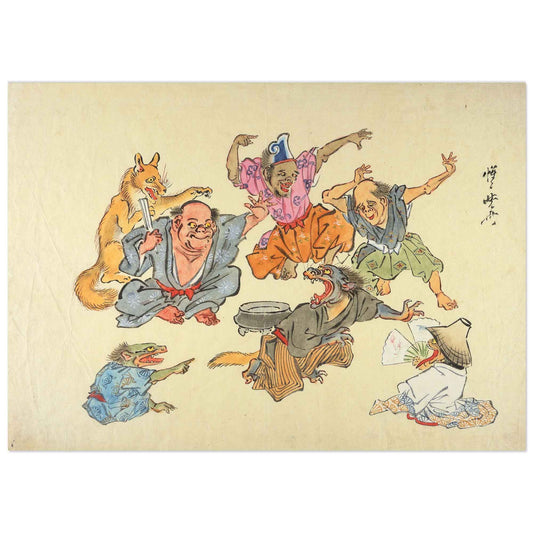
Demons, spirits and a mischievous fox in one of Kyosai’s wildest supernatural scenes.
See the print →Kitsune: The Mystical Fox Spirits

Fox fires on New Year’s Eve at the enoki tree in Ōji, by Utagawa Hiroshige.
What are kitsune?
Kitsune (狐, “fox”) are foxes with magical powers that grow with age and wisdom. They can live for centuries, are masters of shapeshifting, and can be benevolent or malevolent. They are closely associated with Inari, the Shintō deity of rice and prosperity, whose messengers they are.
The nine-tailed fox (kyūbi no kitsune)
According to tradition, a kitsune gains a new tail as it ages and grows in power, up to nine. It is often said to take about a century per tail. The nine-tailed fox (kyūbi no kitsune, 九尾の狐), with white or golden fur, is the peak of this evolution: its powers are almost divine, and Tamamo-no-Mae is its most famous example. Some stories even mention the tenko (天狐), the “celestial fox”, raised to the rank of a deity.
Good foxes and bad foxes
- Zenko (善狐), the good foxes: messengers of Inari, they protect humans and bring prosperity. Their statues guard Inari shrines all over Japan.
- Yako (野狐), the wild foxes: mischievous or malevolent, they play tricks on humans and can even possess them. This possession, kitsunetsuki (狐憑き), showed itself through strange behaviour and an irresistible craving for fried tofu, and required an exorcism.
Kitsune powers
Their main gift is shapeshifting: they readily take the form of beautiful young women, sometimes young men, children or even objects. They also master illusions and kitsune-bi (狐火), supernatural will-o’-the-wisps floating in the night. And when it rains under a bright sun, the Japanese say it is a kitsune no yomeiri, “the fox’s wedding”.
How to spot a disguised kitsune
- Its shadow or reflection betrays its true form, sometimes with a tail.
- It is afraid of dogs, its natural predators.
- It cannot resist aburaage, fried tofu, its favourite food.
- According to some stories, drunk people can see through its disguise.
Fox wives
A recurring theme: a man saves a fox, then meets a beautiful woman and marries her. They have children, until the day the family dog reveals the wife’s true nature. She must then leave, promising to watch over her children. The most famous of these fox wives is Kuzunoha (葛の葉), who married Abe no Yasuna and is said to be the mother of the diviner Abe no Seimei.

A moonlit kitsune scene by the last great master of ukiyo-e.
See the print →Tengu: Long-Nosed Guardians of the Mountains

Tengu and Buddhist monk, by Kawanabe Kyosai. The tengu wears the cap and pompom sash of Shugendō practitioners.
What are tengu?
Tengu (天狗, literally “heavenly dog”) are bird-like yōkai who live in mountains and forests. Their image has changed a great deal over the centuries:
- Originally, arriving from China with Buddhism, they were evil spirits, enemies of the faith and bringers of disaster.
- In the classical period (Heian and Kamakura), they take on a more bird-like look and become attached to mountains.
- From the Edo period, they become guardians of the mountains and the martial arts: mischievous, proud sword masters, but not necessarily evil.
The two main types of tengu
The daitengu (大天狗), or great tengu, looks human, with a red face, a very long nose, white hair and beard, a feather fan (hauchiwa) and an ascetic’s outfit. The most famous, Sōjōbō (僧正坊), king of the tengu of Mount Kurama, is said to have taught swordsmanship to the young Minamoto no Yoshitsune, one of Japan’s greatest heroes.
The karasu-tengu (烏天狗), or crow tengu, has a bird’s head with a beak, black feathers, large wings and clawed feet. It ranks below the daitengu.
Their powers
Tengu fly and have superhuman strength and unrivalled mastery of the sword. They are also credited with shapeshifting, telepathy and the power to unleash the wind with a single sweep of their fan.
Tengu in culture
Mount Takao (高尾山), near Tokyo, is one of their sacred mountains: the Yakuō-in temple there draws many visitors every year, welcomed by tengu statues. Red long-nosed masks are worn at festivals, and the expression tengu ni naru (天狗になる), “to become a tengu”, means to become conceited, a nod to their legendary arrogance.

Tengu, by Katsushika Hokusai.
Kappa: The River Tricksters

Keyamura Rokusuke and the kappa, from the series Honchō kendō ryakuden (1843-1847).
What are kappa?
Kappa (河童, “river child”) are water yōkai found all over Japan. The size of a child, they have green, scaly skin, a turtle shell on their back, webbed hands and feet, a beak and a fishy smell. But their most important feature is on top of their head: a dish-shaped hollow, the sara, filled with water.
Their weak spot
This water is the source of their strength. If it spills, the kappa loses all its powers, and may even die if the dish empties completely. It must then return to the river to refill it.
Tricksters, dangerous… and sometimes helpful
As pranksters, kappa peek under kimonos, break wind loudly, steal crops, especially cucumbers, and challenge passers-by to sumo. On the dark side, they drown the careless, especially children, and are said to pull out their victims’ shirikodama, a mythical organ believed to hold the soul. But they always keep their word, can befriend humans who treat them well, and know the art of setting broken bones.
How to defeat a kappa
- The bow: bow deeply. Being polite, the kappa will bow back, and the water on its head will spill.
- The cucumber: carve your family name on a cucumber and throw it into the water. The kappa will spare your family.
- Sumo: accept its challenge and pull off one of its arms, which come off easily. To get it back, it will promise you anything.
- The unorthodox method: some stories claim a good fart is enough to drive it away!

Outwitting the trickster: repelling a kappa with a fart, by Tsukioka Yoshitoshi, 1881.
Kappa in modern Japan
Many rivers still have “Beware of kappa” signs, originally meant to stop children from swimming alone and now tourist curiosities. Kappa-maki, the cucumber sushi roll, is named after their favourite vegetable, and a kappa is the mascot of the Kizakura sake brewery.

Remember the sumo trick? Yoshitoshi shows kappa wrestling on the riverbank.
See the print →Tsukumogami: When Objects Come Alive

Tsukumogami (付喪神) from the Hyakki yagyō emaki (百鬼夜行絵巻), the illustrated scroll of the night parade of one hundred demons.
What are tsukumogami?
Tsukumogami are objects that come to life after existing for a hundred years. The word combines tsukumo, which can also be written 九十九, “ninety-nine”, and kami (神), “deity, spirit”. Behind this idea lies a belief shared by Buddhism and Shintō: everything has an essence. Objects used with care develop a soul, while those that are abandoned or mistreated may become resentful.
The main tsukumogami
- Kasa-obake (傘お化け), the umbrella: an old one-eyed umbrella with a long tongue and one or two legs, hopping about to scare passers-by. A harmless prankster.
- Chōchin-obake (提灯お化け), the lantern: a paper lantern whose tear forms a mouth, with a long dangling tongue, floating in the air.
- Bakezōri (化け草履), the straw sandal: it runs around at night singing, in revenge for being neglected.
- Biwa-bokuboku (琵琶牧々) and koto-furunushi (琴古主): musical instruments that play by themselves, sometimes to bewitch their listeners.
- Kameosa (瓶長), the sake jar: a friendly old jar on legs, said to bring luck to brewers.

Lantern ghost (chōchin-obake), print by Shunkōsai Hokuei.
A lesson in wisdom
Tsukumogami teach respect for objects: don’t waste, repair rather than replace, thank the things that serve us. The same idea lives on in Hari-kuyō (針供養), the “festival of broken needles”, held every year in February or December depending on the region. Old sewing needles are thanked for their service by sticking them into soft tofu or konnyaku before parting with them respectfully. Just enough to keep them from becoming resentful tsukumogami.
Yūrei: Japanese Ghosts vs Yōkai

Yūrei, Bakemono no e scroll, Brigham Young University.
What are yūrei?
Yūrei (幽霊) are the ghosts of dead people who cannot reach the afterlife. They are often confused with yōkai, but differ on several points:
| Yūrei | Yōkai | |
|---|---|---|
| Origin | Dead humans | Never human (creatures, spirits, transformed objects) |
| Reason to exist | Unfinished business | Exist naturally in the spirit world |
| Appearance | White burial kimono, long black hair | Endlessly varied |
| Legs | Often missing: they float | Usually present |
| Can they be laid to rest? | Yes, by appeasing their grudge | No, they are not “cursed” |
The classic look of yūrei
Fixed by kabuki theatre and Edo prints, it has become universal: a white burial kimono (kyōkatabira), long, loose black hair hiding the face, pale skin, hands hanging limply, no feet, and hitodama (人魂), small bluish flames floating around them. Japanese horror cinema, from Ring to The Grudge, inherited it directly.
Types of yūrei
Onryō (怨霊), vengeful ghosts: the most fearsome, who died holding a deep grudge. They cause illness, disasters and family curses. Among the most famous: Oiwa, the betrayed wife of the Yotsuya kaidan; Okiku, the murdered servant endlessly counting plates at the bottom of a well; and Sugawara no Michizane, an exiled scholar whose spirit was appeased by deifying him as Tenjin, god of learning.
Ubume (産女), ghost mothers: women who died in childbirth, appearing with a baby in their arms and asking passers-by to hold it. The baby grows heavier and heavier, but whoever holds on until dawn receives supernatural strength.
Funayūrei (船幽霊), sea ghosts: the souls of the drowned, rising from the waves and asking for a ladle to fill the boat with water and sink it. The sailors’ trick: hand them a ladle with a hole in it.
More Famous Yōkai: Demon Cats, the Snow Woman and the Giant Skeleton
Beyond the great families, hundreds of yōkai populate Japanese legends. Here are the best known, from the most feared to the most endearing.
Bakeneko (化け猫) and nekomata (猫又), the cat yōkai

The bakeneko (化け猫, “changing cat”) is a house cat that becomes a yōkai as it grows old. You can tell by its increasingly human ways: it stands upright, dances with a towel on its head, talks, licks the oil from lamps and finally takes human form, sometimes that of its mistress, whom it has devoured. The most famous story, the Nabeshima cat monster, tells how a vengeful cat attacks the family of a lord of Saga, on the island of Kyūshū.
The nekomata (猫又) is an even more advanced stage: a very old cat whose tail has split in two. More powerful than the bakeneko, it is said to work the dead like puppets. It appears as early as the 14th century in Yoshida Kenkō’s Essays in Idleness (Tsurezuregusa). It is said that people once cut kittens’ tails to stop them from becoming nekomata. In contrast, the maneki-neko, the lucky cat raising its paw, shows the kindly face of cats in Japanese culture.
Yuki-onna (雪女), the snow woman

Yuki-onna, by Sawaki Sūshi, Hyakkai zukan, 1737.
The yuki-onna is a woman of icy beauty, with white skin and a spotless kimono, who appears in mountain snowstorms. She freezes lost travellers with her frozen breath, or leads them into the storm.
Her best-known legend was popularised by Lafcadio Hearn in Kwaidan (1904). Caught in a storm, two woodcutters take shelter in a hut. The yuki-onna kills the older man but spares young Minokichi, on condition that he never speaks of that night. Years later, he marries a young woman, O-Yuki, who bears him ten children. One evening, he finally tells her about his strange encounter… O-Yuki then reveals herself as the snow woman. She spares him for their children’s sake, then vanishes in a cloud of frost.
Kuchisake-onna (口裂け女), the slit-mouthed woman
This is a modern urban legend that caused real panic in Japan in 1979. A beautiful woman wearing a surgical mask approaches a child and asks: “Watashi, kirei?” (“Am I pretty?”). If the child says no, she kills them with her scissors. If the child says yes, she removes her mask, reveals a mouth slit from ear to ear, and asks again: “Kore demo?” (“How about now?”). Another yes, and she carves the same mouth on the child.
To escape her, the rumour advised answering that she looked “average”, throwing her sweets that she would stop to pick up, or saying the word “pomade” three times, a smell she supposedly hated. In 1979, schools walked pupils home in groups and police stepped up patrols, although no attack was ever confirmed.
Gashadokuro (がしゃどくろ), the giant skeleton

Takiyasha the Witch and the Skeleton Spectre, triptych by Utagawa Kuniyoshi, around 1844.
A colossal skeleton, made from the bones of famine victims and soldiers left unburied, which roams at night with chattering teeth and tears the heads off late travellers. A ringing in the ears is said to signal its approach. A little-known fact: the name gashadokuro only appears in the 20th century, in yōkai books of the 1960s, largely inspired by this famous Kuniyoshi triptych.
Kodama (木霊), the tree spirits
Kodama are the spirits that live in very old trees. When an echo answers a shout in the mountains, it was once said to be their voice: in Japanese, the word also means echo. Cutting down a tree inhabited by a kodama brings misfortune on the woodcutter and his village. This is why some sacred trees are still encircled with a straw rope, the shimenawa, to mark the presence of a spirit.
Studio Ghibli made them famous in Princess Mononoke (1997) as small, white, translucent figures whose heads rattle as they turn. In the film, their presence is the sign of a healthy forest.
Umibōzu (海坊主), the sea monk
On a calm night at sea, the water suddenly starts to churn, and a black giant with a round, smooth head, like a Buddhist monk’s, rises in front of the boat. The umibōzu (“sea monk”) can smash the ship with one blow or capsize it. Most often, it asks for a barrel or a ladle to fill the boat with water and sink it. The fishermen’s trick: hand it a bottomless barrel, and sail away while it wears itself out bailing. It is also wise to keep quiet: speaking about it in its presence is said to be enough to anger it.
Tsuchigumo (土蜘蛛), the earth spider
The tsuchigumo is a giant spider, depicted in some versions with a demon’s face, a tiger’s body and spider legs, that hides in mountains or caves. In the ancient chronicles, the name first referred to clans that resisted imperial power, described as beings living underground. It later became a monster in its own right.
Its most famous legend pits it against the warrior Minamoto no Raikō, already the victor over Shuten-dōji. Bedridden with a mysterious fever, Raikō is visited at night by a strange monk who tries to bind him with threads. He strikes it with his sword, then follows the trail of blood with his companions to a cave, where they find and kill the giant spider. Raikō recovers at once. The story inspired the Noh play Tsuchigumo, still performed today, and many woodblock prints.

The tsuchigumo, the monstrous spider defeated by the hero Minamoto no Raikō.
See the print →Jorōgumo (絡新婦), the spider woman

Jorōgumo, the spider woman.
A spider that, as it ages, gains the power to turn into a beautiful woman. She lures men to her home, sometimes with the sound of a biwa, binds them in her silk and devours them slowly. Her shadow, they say, betrays her true nature.
The most famous legend takes place at the Jōren Falls, on the Izu peninsula. A woodcutter resting by the water feels silk threads winding around his ankle. Suspicious, he ties them to a stump… which is instantly torn out and dragged to the bottom of the falls. Modern manga and anime often turn her into a tragic figure, a “monster who wanted to be loved”.
Rokurokubi (ろくろ首), the long-necked woman
By day, the rokurokubi looks like any other woman. But at night, while she sleeps, her neck stretches to an enormous length and her head goes prowling around the house, licking lamp oil or spying on sleepers. Most of the time, she is not even aware of her nature. There is a more sinister variant, the nukekubi (抜け首), whose head detaches completely from the body to attack its prey. This is the version Lafcadio Hearn tells in the story “Rokuro-Kubi” in Kwaidan.
Noppera-bō (のっぺら坊), the faceless ghost
It looks like an ordinary person, until it turns around: where the face should be, there is only smooth skin, with no eyes, nose or mouth. In the most famous story, the terrified traveller runs away and finds refuge with a noodle seller… who also passes a hand over his face and wipes it smooth. The noppera-bō does no harm: it is content to terrify.
Nurarihyon (ぬらりひょん), the master of yōkai
An old man with an elongated head, dressed like a wealthy merchant, walks into a house at the busiest time of the evening. He sits down, helps himself to tea, smokes a pipe and behaves like the master of the house… and nobody thinks to throw him out. The nurarihyon is one of the most mysterious yōkai: old sources say almost nothing about him. In the 20th century, yōkai books made him the supreme leader of all yōkai, an image taken up by the manga Nura: Rise of the Yokai Clan (Nurarihyon no Mago).
Zashiki-warashi (座敷童子), the lucky child spirit
The zashiki-warashi is a small, child-like spirit with red cheeks and a bowl haircut, living in the reception rooms of old houses, mostly in the Iwate region of northern Japan. Mischievous, it messes up pillows and leaves tiny footprints in the ashes. But it brings good fortune: the family it lives with prospers. If it leaves, the family’s fortune goes with it. The folklorist Yanagita Kunio records several of these stories in his Tales of Tōno, and some inns in the Tōhoku region are still said to be home to one.
Tanuki (狸), the shapeshifting raccoon dog
The tanuki is a real animal, the raccoon dog, but folklore turned it into a jolly, mischievous shapeshifter: the bake-danuki. It transforms by placing a leaf on its head, drums on its big belly on full-moon nights and loves fooling humans, often with fake money made of leaves. In the tale Bunbuku chagama, a tanuki that turns itself into a teakettle can no longer change back. Its smiling Shigaraki ceramic statues, with a straw hat and a sake bottle, greet customers outside many restaurants.
Amabie (アマビエ), the yōkai that protects against epidemics
In 1846, in Higo province (today’s Kumamoto prefecture), a strange glowing creature rises from the sea: a scaly body, long hair, a bird’s beak and three fins for legs. The amabie foretells six years of good harvests, then adds: if an epidemic comes, show my picture to the sick. The scene is known from a single printed broadsheet of the time. In 2020, at the start of the Covid-19 pandemic, the amabie went viral in Japan: drawings, pastries, figurines… Japan’s Ministry of Health even used it in its prevention campaign.
Nurikabe (ぬりかべ), the invisible wall
On a dark road, the traveller walks on… without ever getting anywhere: an invisible wall blocks the way, and he may walk on the spot for hours. The trick is to strike the bottom of the “wall” with a stick to make it vanish. Thanks to GeGeGe no Kitarō, the nurikabe is now shown as a big, good-natured white wall with eyes and little legs.
Makuragaeshi (枕返し), the pillow flipper
It slips into bedrooms at night and moves the sleeper’s pillow, so they wake up with their head at the foot of the bed. Often shown as a small figure, it embodies the anxiety linked to sleep, the time when we are defenceless.
Betobeto-san (べとべとさん), the footsteps that follow you
Invisible, it follows lone walkers at night, making a “beto, beto” sound. To get rid of it, simply step aside and say politely: “Betobeto-san, osaki ni dōzo” (“Betobeto-san, please, go ahead”). The footsteps pass you, then fade away.
Ame-onna (雨女), the rain woman
This female yōkai brings rain wherever she goes. Today, people jokingly call someone an ame-onna when bad weather seems to follow them on every outing, and the opposite a hare-otoko (晴れ男), “sunshine man”.
Yōkai in Modern Culture: Anime, Games and Beyond
Studio Ghibli
Spirited Away (2001) is one of the biggest successes in animation history, and a true parade of spirits: No-Face (Kaonashi), Miyazaki’s own creation; Yubaba, inspired by the mountain witch (yama-uba); Kamaji, the six-armed boiler man who recalls the tsuchigumo; the radish spirit and the polluted river god. Princess Mononoke (1997) features kodama, the tree spirits, and great animal gods, while Pom Poko (1994) tells of shapeshifting tanuki resisting urbanisation.
Video games
- Pokémon draws heavily on folklore: Ninetales is inspired by the nine-tailed fox, Froslass by the yuki-onna, Banette by haunted objects.
- Yo-kai Watch (2013) makes collecting yōkai its very premise, with hundreds of creatures inspired by tradition.
- Ōkami (2006) casts the player as the goddess Amaterasu in a mythological Japan styled after woodblock prints, and Nioh (2017) pits the player against famous yōkai.
Manga and anime
- GeGeGe no Kitarō by Shigeru Mizuki, the most influential yōkai work of the 20th century, published in English as Kitaro. Mizuki also won Best Album at the 2007 Angoulême International Comics Festival for NonNonBa, childhood memories full of yōkai.
- Natsume’s Book of Friends (Natsume Yūjin-chō): a high-school boy inherits a notebook containing the names of hundreds of yōkai. A gentle, melancholy story.
- Mushishi: primitive creatures close to yōkai, in a contemplative atmosphere.
- Toilet-Bound Hanako-kun and Dandadan mix traditional yōkai, urban legends and high-octane action.
In the West
Kitsune, oni and hannya masks are among the most requested designs in tattoo studios, often in the traditional irezumi style. Yōkai also appear on clothing from Japanese and Western streetwear brands, and inspire a new generation of fantasy novels.
How to Protect Yourself from Yōkai
Traditional protections
- Salt (塩, shio): a symbol of purity in Shintō, it is placed in small cones at the entrance of houses and restaurants, and sumo wrestlers throw it into the ring before each bout.
- Ofuda (御札): paper talismans from shrines, hung above doors and renewed every year.
- Omamori (お守り): small brocade pouches holding a prayer, carried for health, safety or love.
- Sutras: reciting the Heart Sutra (般若心経) is considered one of the most powerful protections against spirits.
- Blades: a small sword, the mamori-gatana, was once laid on the body of the deceased to keep evil spirits away.
- Mirrors: sacred objects in Shintō, said to reveal the true nature of beings.
- Dogs: they sniff out disguised kitsune, and dog figurines (inu-hariko) traditionally protect children.
Superstitions to respect
- Don’t whistle at night: it is said to attract snakes and spirits.
- Don’t cut your nails after dark.
- If someone calls your name only once in the dark, don’t answer: according to a popular etymology, people say “moshi moshi” on the phone to prove they are not yōkai, since spirits supposedly cannot repeat the word.
- Respect nature, thank your objects before parting with them, and keep your house clean: the akaname, the “filth licker”, loves dirty bathrooms.
What science explains
Many phenomena attributed to yōkai now have rational explanations. Fox fires (kitsune-bi) were probably will-o’-the-wisps, marsh gas igniting spontaneously. Sleep paralysis, called kanashibari (金縛り) in Japan, explains many night-time visits. And the creaking of old houses, blamed on the yanari, is mostly wood shifting. But even without believing in them, following these traditions keeps alive a respect for nature, objects and others.
List of Yōkai from A to Z: The Complete Bestiary
Here is an overview of the main yōkai, from the most famous to the strangest. For those that already have their own section in this guide, follow the link.
A
Abumi-guchi (鐙口): the stirrup of a rider killed in battle, turned into a small furry creature that faithfully awaits its master’s return.
Abura-akago (油赤子): a flame child that sneaks into houses to lick the oil from lamps.
Akaname (垢嘗): the “filth licker”, who comes at night to lick clean poorly kept bathrooms.
Amabie (アマビエ): the prophetic mermaid who protects against epidemics. See above.
Amanojaku (天邪鬼): a small demon that reads minds and pushes people to do the opposite of what they want.
Ame-onna (雨女): the rain woman. See above.
Aobōzu (青坊主): a blue-skinned, one-eyed monk who haunts empty houses and barley fields.
B
Bakeneko (化け猫): the cat that becomes a yōkai with age, dancing, talking and taking human form. See above.
Baku (獏): a chimera with an elephant’s trunk that devours nightmares. People call on it before falling asleep to get a good night’s rest.
Betobeto-san (べとべとさん): the invisible footsteps that follow you at night. See above.
Binbōgami (貧乏神): the god of poverty, who moves into houses and ruins their occupants.
Biwa-bokuboku (琵琶牧々): the lute that plays by itself. See tsukumogami.
C
Chōchin-obake (提灯お化け): the haunted lantern. See tsukumogami.
D
Daidarabotchi (ダイダラボッチ): a giant so huge that he is said to have shaped mountains and dug lakes with his own hands.
Dorotabō (泥田坊): a one-eyed old man who rises from abandoned rice fields shouting “Give me back my fields!”.
F
Funayūrei (船幽霊): the ghosts of the drowned. See yūrei.
Futakuchi-onna (二口女): a woman with a second mouth at the back of her head, hidden under her hair, which secretly devours food.
G
Gashadokuro (がしゃどくろ): the giant skeleton. See above.
Goryō (御霊): the vengeful spirits of nobles who died unjustly. It was to appease them that the festival that became Kyoto’s famous Gion Matsuri began, in the 9th century.
H
Hannya (般若): the female demon mask of Noh theatre, with horns and a terrifying grin. See above.
Haradashi (腹出し): a comic yōkai with a face drawn on its belly.
Hitotsume-kozō (一つ目小僧): a small, bald, one-eyed monk who likes to startle people without harming them.
Hyōsube (ひょうすべ): a hairy cousin of the kappa from Kyūshū, who loves aubergines and whose laughter is contagious… and dangerous.
I
Ikiryō (生霊): the spirit of a living person that leaves the body out of jealousy or hatred. In The Tale of Genji, Lady Rokujō’s torments her rivals.
Inugami (犬神): a dog spirit bound to the service of certain families, said to be as powerful as it is fearsome.
Itsumade (以津真天): a monstrous bird that circles above the dead left unburied, crying “Itsu made?” (“Until when?”).
J
Jorōgumo (絡新婦): the spider woman. See above.
Jubokko (樹木子): a tree that grows on old battlefields and feeds on the blood of passers-by.
K
Kamaitachi (鎌鼬): a trio of wind weasels. The first knocks its victim down, the second cuts them, the third heals the wound at once, which stays painless.
Kappa (河童): the river trickster. See the kappa section.
Kasa-obake (傘お化け): the one-eyed umbrella. See tsukumogami.
Keukegen (毛羽毛現): a small ball of hair that lives in damp corners of houses and brings illness.
Kitsune (狐): the fox spirit. See the kitsune section.
Kodama (木霊): the spirit of old trees, the voice of the echo in the mountains. See above.
Konaki-jiji (子泣き爺): an old man who cries like a baby by the roadside. Whoever picks him up feels him grow as heavy as stone.
Kuchisake-onna (口裂け女): the slit-mouthed woman. See above.
M
Makuragaeshi (枕返し): the pillow flipper. See above.
Mikoshi-nyūdō (見越し入道): a monk who grows taller the higher you look up at him. To make him disappear, shout “Mikoshita!” (“I saw you coming!”).
Mujina (狢): a shapeshifting badger that likes to take the form of a noppera-bō, as in Lafcadio Hearn’s famous story.
N
Namazu (鯰): the giant catfish living under Japan, causing earthquakes when it thrashes about. Only the god Kashima can keep it still.
Nekomata (猫又): the old cat with a forked tail, even more powerful than the bakeneko. See above.
Ningyo (人魚): a fish with a human face. Eating its flesh is said to grant extraordinary longevity: the legend of the nun Yao Bikuni, who supposedly lived 800 years, comes from it.
Nobusuma (野衾): a flying creature, close to the flying squirrel, that swoops onto travellers’ faces at night.
Noppera-bō (のっぺら坊): the faceless ghost. See above.
Nue (鵺): a chimera with a monkey’s head, a tanuki’s body, a tiger’s legs and a snake for a tail, shot down with an arrow by the warrior Minamoto no Yorimasa above the imperial palace.
Nurarihyon (ぬらりひょん): the old man with an elongated head, leader of the yōkai. See above.
Nure-onna (濡女): a creature with a woman’s head and a snake’s body, lying in wait for fishermen on the shore.
Nurikabe (ぬりかべ): the invisible wall. See above.
O
Obariyon (おばりよん): a yōkai that jumps onto passers-by’s backs demanding to be carried, and grows heavier and heavier.
Ōkubi (大首): a gigantic head that appears in the night sky.
Oni (鬼): the Japanese demon. See the oni section.
R
Raijū (雷獣): the thunder beast, an animal made of lightning that falls from the sky with thunderbolts.
Rokurokubi (ろくろ首): the woman whose neck stretches while she sleeps. See above.
S
Samebito (鮫人): a shark man whose tears turn into gems.
Satori (覚): a mountain monkey that reads minds. It can only be outwitted by an unplanned act it could not foresee.
Shikigami (式神): spirits summoned and commanded by masters of onmyōdō, such as Abe no Seimei.
Shirime (尻目): a man who drops his trousers in front of passers-by to show them… an eye where his anus should be.
Shiro-uneri (白溶裔): an old forgotten rag turned into a serpentine creature that wraps itself around people.
Shōjō (猩々): sea spirits with red faces and flaming hair, great lovers of sake.
Shuten-dōji (酒呑童子): the king of the oni. See the Big Three.
T
Tamamo-no-Mae (玉藻前): the nine-tailed fox woman. See the Big Three.
Tanuki (狸): the jolly, mischievous shapeshifting raccoon dog. See above.
Teke-teke (テケテケ): a modern urban legend. Cut in half by a train, a girl drags herself along on her elbows, making a “teke-teke” sound.
Tengu (天狗): the mountain guardian. See the tengu section.
Tesso (鉄鼠): the monk Raigō, who died of rage, is said to have turned into a giant rat leading an army of rats that ravaged the sutras of Enryaku-ji temple.
Tsuchigumo (土蜘蛛): the giant spider defeated by Minamoto no Raikō, immortalised in Yoshitoshi’s print. See above.
Tsukumogami (付喪神): animated objects. See the tsukumogami section.
Tsurube-otoshi (釣瓶落とし): a giant head that drops from treetops onto passers-by.
U
Ubume (産女): the ghost mother. See yūrei.
Umibōzu (海坊主): the black giant that rises from the waves to capsize boats. See above.
Ungaikyō (雲外鏡): an old mirror that reveals the true nature of those who look into it.
Ushi-oni (牛鬼): a monster with a bull’s head and a spider’s body, haunting the coasts of western Japan.
W
Wani (和邇): a legendary sea monster. In the Kojiki, the white hare of Inaba crosses the sea by hopping on their backs, after tricking them.
Wanyūdō (輪入道): a flaming cartwheel with a monk’s face, which devours the soul of anyone who dares to look at it.
Y
Yama-uba (山姥): the mountain witch, a fearsome ogress, but said to have raised the hero Kintarō.
Yanari (家鳴): small spirits that make houses creak and shake at night.
Yatagarasu (八咫烏): the three-legged crow that guided the legendary Emperor Jinmu. It is now the emblem of Japan’s national football team.
Yuki-onna (雪女): the snow woman, of icy beauty. See above.
Yūrei (幽霊): the Japanese ghost. See the yūrei section.
Z
Zashiki-warashi (座敷童子): the lucky child spirit. See above.
Zunbera-bō (ずんべら坊): a variant of the noppera-bō, also faceless.
Why Yōkai Still Matter Today
Why have these creatures survived modernisation, electricity and science? Because they have always done much more than play the bogeyman.
Yōkai give a face to the inexplicable: the noise in the empty house, the road that never seems to end, the sudden illness. They pass on lessons: don’t go near the river alone, respect objects, don’t give in to jealousy. They also help people get through disasters, from the namazu blamed for earthquakes to the amabie, a yōkai that protects against epidemics and went viral again during the Covid-19 pandemic. Finally, they connect people to nature: every tree, every river, every mountain may be home to a spirit.
The folklorist Yanagita Kunio, father of Japanese folklore studies with his Tales of Tōno (1910), understood this: yōkai tell the intimate story of a people, its fears, its hopes and its relationship with the invisible world. Today you can meet them along the Mizuki Shigeru Road in Sakaiminato, lined with more than 170 bronze statues, or at the Miyoshi Mononoke Museum, near Hiroshima.
The next time you hear footsteps behind you and see no one, when your umbrella seems to give you a funny look or rain falls under a bright sun, remember: you may not be alone. And just in case, stay polite.
Further Reading
Books
- Shigeru Mizuki, Kitaro and NonNonBa (Drawn & Quarterly): the founding manga of the yōkai revival.
- Lafcadio Hearn, Kwaidan: the great Japanese ghost stories, including those of the yuki-onna and the mujina.
- Michael Dylan Foster, The Book of Yōkai: the most accessible academic reference.
- Matthew Meyer, The Night Parade of One Hundred Demons: a modern illustrated bestiary.
- Toriyama Sekien, Japandemonium Illustrated: the complete translation of his famous Edo bestiaries.
Online
- yokai.com: Matthew Meyer’s illustrated encyclopedia.
- The Nichibunken yōkai database (International Research Center for Japanese Studies), for researchers.
- Village of Strange, our blog devoted to bestiaries and strange legends.
On Wallango
Discover the artists who brought yōkai to life: Utagawa Kuniyoshi, Katsushika Hokusai and Kawanabe Kyosai, plus our full selection of Japanese woodblock prints.