
-
The Virgin and Child with a Monkey, Albrecht Dürer
Vendor:WallangoRegular price From $50.00Regular priceUnit price per -
Saint Jerome in His Study, Albrecht Dürer
Vendor:WallangoRegular price From $50.00Regular priceUnit price per -
The Four Horsemen of the Apocalypse – Albrecht Dürer Print – Woodcut from The Apocalypse (1498)
Vendor:WallangoRegular price From $60.00Regular priceUnit price per -
Sun of Righteousness, Albrecht Dürer (c. 1500)
Vendor:WallangoRegular price From $50.00Regular priceUnit price per -
Melencolia I - Albrecht Dürer (1514) - Limited Edition Fine Art Print
Vendor:WallangoRegular price $240.00Regular priceUnit price per -
Saint Eustace, Albrecht Dürer (1501)
Vendor:WallangoRegular price From $50.00Regular priceUnit price per -
Saint Michael Fighting the Dragon – Albrecht Dürer Print – Woodcut from The Apocalypse (1498)
Vendor:WallangoRegular price From $50.00Regular priceUnit price per -
Coat of Arms with a Skull by Albrecht Dürer – Gothic Memento Mori Print
Vendor:WallangoRegular price From $50.00Regular priceUnit price per -
The little horse, Albrecht Dürer (1505)
Vendor:WallangoRegular price From $50.00Regular priceUnit price per -
Knight, Death and the Devil Poster - Albrecht Dürer
Vendor:WallangoRegular price From $50.00Regular priceUnit price per -
The Sea Monster, Albrecht Dürer
Vendor:WallangoRegular price From $50.00Regular priceUnit price per -
The Men's Bath House, Albrecht Dürer
Vendor:WallangoRegular price From $50.00Regular priceUnit price per -
St. Jerome in His Cell, Albrecht Dürer
Vendor:WallangoRegular price From $50.00Regular priceUnit price per -
St. George Killing the Dragon, Albrecht Dürer
Vendor:WallangoRegular price From $50.00Regular priceUnit price per -
Ptolemy with the celestial globe
Vendor:WallangoRegular price From $50.00Regular priceUnit price per -
The Rhinoceros – Albrecht Dürer
Vendor:WallangoRegular price From $50.00Regular priceUnit price per -
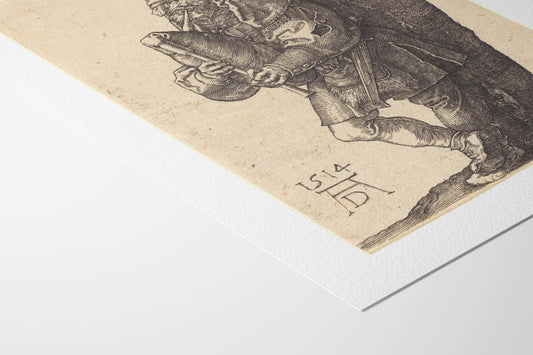
The Bagpiper — Albrecht Dürer (1514)
Vendor:WallangoRegular price From $50.00Regular priceUnit price per -
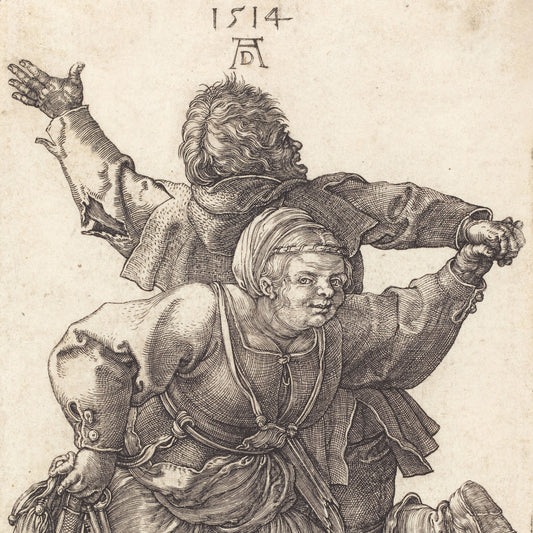
Albrecht Dürer — Peasant Couple Dancing (1514)
Vendor:WallangoRegular price From $50.00Regular priceUnit price per






Museum-quality reproductions of the engravings and woodcuts of Albrecht Dürer, the greatest printmaker of the Renaissance. From the visions of the Apocalypse to the three Master Engravings, these prints made his name across Europe more than five centuries ago and have lost none of their power.
Albrecht Dürer (1471-1528) was a painter, printmaker and theorist from Nuremberg. Trained as a goldsmith before becoming a painter, he travelled twice to Italy and brought back the perspective, proportion and classical forms of the Italian Renaissance, which he combined with the precision of the German tradition. His prints, sold all over Europe and signed with his famous AD monogram, made him one of the first artists to become famous across Europe through printmaking.

The Master Engravings: Dürer's technical pinnacle
Three copper engravings made in 1513 and 1514 are known as the Meisterstiche, the Master Engravings. They mark the summit of engraving in the Renaissance, both in technique and in depth of meaning.

Knight, Death and the Devil (1513) shows an armoured knight riding steadily through a dark gorge, ignoring Death, who holds up an hourglass, and the Devil, who follows him. Every link of the armour, every hair of the horse and the dog, is engraved with astonishing precision. The print is usually read as an image of the Christian knight, unshaken by fear and temptation.
Saint Jerome in His Study (1514) is its peaceful opposite: the scholar-saint writes in a sunlit room, his lion and a dog asleep at his feet, while the light from the leaded windows falls across the books, the skull and the hourglass. It is a lesson in perspective and one of the most loved images in the history of printmaking.
Melencolia I (1514) is the most enigmatic of the three. A winged figure sits brooding among the tools of geometry and craft: a polyhedron, a sphere, a ladder, scales, an hourglass and a magic square whose rows all add up to 34, with the date 1514 in its bottom row. Art historians have proposed countless readings, most often a portrait of the melancholy of creative genius.
Limited Edition Highlight
Don't miss our reproduction of Melencolia I in a limited edition of only 20 numbered prints on premium Ilford Cotton Textured 310gsm paper. Each print includes a certificate of authenticity.
View Limited Edition →The Apocalypse woodcuts
In 1498, at the age of 27, Dürer published the Apocalypse: fifteen large woodcuts illustrating the Book of Revelation. Until then, the woodcut was seen as a cheap popular medium; Dürer turned it into a major art, with dense hatching, crowds of figures and a sense of movement never seen before. In The Four Horsemen of the Apocalypse, his most famous image, the four riders charge across the page from left to right, trampling the people of the earth beneath their horses. Saint Michael Fighting the Dragon shows the archangel and his angels battling the dragon and its demons in the sky, above a calm landscape. Published at a time when many feared the end of the world around the year 1500, the series spread Dürer's fame across Europe.
Religious engravings and devotional prints
Dürer also engraved many smaller devotional images, intended both for private prayer and for collectors. In The Virgin and Child with a Monkey (around 1498), Mary sits in a meadow before a Nuremberg landscape, a chained monkey at her feet. Saint Eustace (around 1501), his largest engraving, shows the hunter kneeling before a stag with the crucifix between its antlers, surrounded by horses and hounds drawn with extraordinary care. The Sun of Righteousness (around 1499) depicts Christ as judge, his eyes blazing like the sun, seated on a lion. In woodcut, Saint Jerome in His Cell (1511) returns to the scholar at his desk, and Saint George Killing the Dragon shows the warrior saint at the height of his battle.
Allegorical and mythological prints
Dürer brought classical and allegorical subjects into Northern art. The Sea Monster (around 1498) shows a bearded sea creature carrying off a nude woman, while her companions flee to the shore, a subject whose source scholars still debate. Coat of Arms with a Skull (1503) is a striking memento mori: a skull on a heraldic shield, beside a young woman courted by a wild man. Among the other prints in the collection, the astronomer Ptolemy with the celestial globe recalls Dürer's lifelong interest in science and the heavens.
Studies from life
Dürer believed that art begins with the careful observation of nature. The Little Horse (1505) is a study of an ideal horse in proportion, and his peasant scenes of 1514, The Bagpiper and Peasant Couple Dancing, show ordinary people with humour and life. The woodcut The Men's Bath House (around 1496-1497) shows a group of men, perhaps his friends, at a public bath, and his famous Rhinoceros (1515), drawn from a sketch and a description sent from Lisbon, shows an animal he never saw, covered in armour-like plates. It remained the European image of the rhinoceros for more than two centuries.
Technical innovation and influence
With the burin, Dürer achieved a control of line never seen before: networks of crosshatching that render tone, volume and texture, from fur and metal to skin and stone. In woodcut, he worked with skilled block cutters to obtain the same refinement. He also organised the sale of his prints across Europe and signed them with his monogram, a large A with a small D beneath it, which became a true trademark. Rembrandt and many later artists studied and collected his prints, and Albrecht Durer engravings remain a reference for printmakers today.
Collecting and displaying Dürer engravings
Original impressions are rare and kept mostly in museums, but a good reproduction lets you live with these works every day. Their black and white lines suit both classic and contemporary interiors: hang the three Master Engravings together in a study or a library, or pair the Four Horsemen and Saint Michael for a dramatic effect. Every print is available in 13 sizes, from A4 to A0, on thick matte archival paper. Free shipping, no minimum order. Shipped rolled in a sturdy tube. For Dürer's colour work, discover our Albrecht Dürer watercolours and nature studies, from the Young Hare to the Large Piece of Turf.
Frequently asked questions about Dürer's engravings
What is Albrecht Dürer's most famous engraving?
Melencolia I (1514), one of his three Master Engravings with Knight, Death and the Devil (1513) and Saint Jerome in His Study (1514). Among his woodcuts, The Four Horsemen of the Apocalypse (1498) is his most famous image.
What is the difference between an engraving and a woodcut?
In an engraving, the lines are cut into a copper plate with a burin and the ink is held in the grooves, which allows very fine detail. In a woodcut, the design is drawn on a block of wood and everything around the lines is cut away, so the image is printed in relief. Dürer excelled at both.
How did Dürer sign his prints?
With his monogram, a large A with a small D beneath it, often accompanied by the date. It is one of the most famous artist's marks in history.
What is the Apocalypse series?
Fifteen large woodcuts illustrating the Book of Revelation, published by Dürer in 1498 as a book with the biblical text. It includes The Four Horsemen and Saint Michael Fighting the Dragon, and established his reputation throughout Europe.