
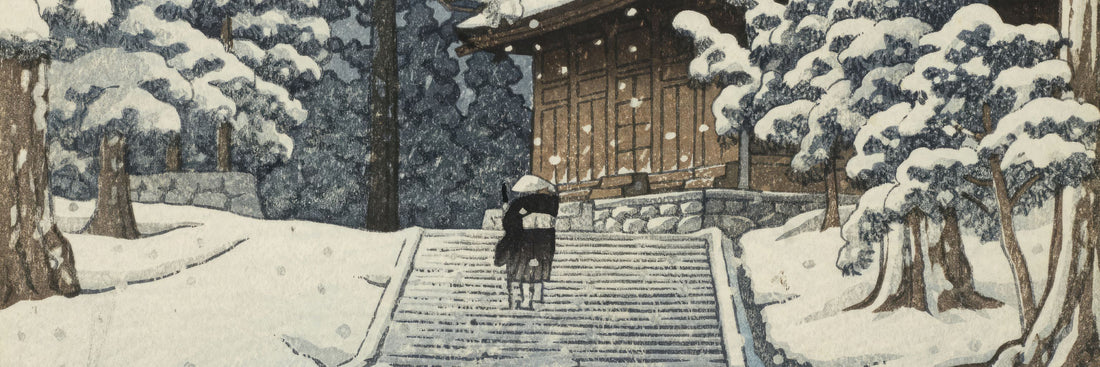
Winter Scenes of Japan: Hasui Kawase's Snowy Woodblock Prints
No artist captured Japanese snow like Kawase Hasui (1883–1957). He designed his first print of falling snow in 1920, and for almost forty years snow remained one of his favourite subjects: temples muffled in white, lone walkers under paper umbrellas, lantern light glowing through a blizzard. Here are eleven of his most beautiful winter scenes, the places behind them, and the final print he worked on before his death.
New to the artist? Start with our biography of Kawase Hasui, the master of light, or browse our Kawase Hasui prints.
Why Snow? Hasui's Winter Leitmotif
Snow suited everything Hasui loved: silence, simplified shapes and subtle light. Under snow, a busy street becomes a quiet line of roofs, and a temple becomes a single dark silhouette against a pale sky. For the carvers and printers of his publisher Watanabe Shōzaburō, these scenes were also a technical challenge: falling snowflakes were often left as unprinted paper, or added with tiny touches of white pigment, while delicate gradations of grey and blue suggest the cold air. (Read how these prints were made in Printmaking Explained by Kawase Hasui.)
1. Tennō-ji Temple in Osaka (Osaka Tennōji)

Shitennō-ji (四天王寺), the "Temple of the Four Heavenly Kings", is often regarded as Japan's first officially administered Buddhist temple. It was founded by Prince Shōtoku in the 6th century, when Buddhism was still new in Japan. The complex has been rebuilt many times, most recently in 1963. In Hasui's print, a single figure under an umbrella crosses the snow-covered courtyard, leaving a trail of footprints.
2. Zōjō-ji Temple in Shiba (Shiba Zōjōji)

Hasui's most famous print, from the series Twenty Views of Tokyo. A woman bends under her umbrella in front of the vermilion gate of Zōjō-ji, the main temple of the Jōdo sect in the Kantō region and the burial place of six Tokugawa shōguns. Its main gate, the Sangedatsumon (1622), is the oldest wooden structure in Tokyo. Fittingly, Hasui was born in this very district of Shiba.
3. Saishō-in Temple in Hirosaki (Hirosaki Saishōin)

In the far north of Honshū, Hirosaki receives some of the heaviest snowfalls in Japan. Saishō-in is known for its five-storey pagoda, built in the 17th century and one of the northernmost in the country. Hasui sets its dark, stacked roofs against a thick snowfall.
4. Honmon-ji Temple in Ikegami (Ikegami Honmonji)

This Nichiren-shū temple in the south of Tokyo stands where the priest Nichiren died in 1282. His teachings founded Nichiren Buddhism, a branch of Mahāyāna Buddhism. Ikegami lies close to Magome, where Hasui lived and worked for much of his life.
5. Snow at Shiba Park (Shiba kōen no yuki)

Back in Shiba, the park that surrounds Zōjō-ji. Hasui returned again and again to the neighbourhood of his childhood, and it is no coincidence that two of his finest snow scenes are set here.
6. Yakumo Bridge at Nagata Shrine in Kobe (Kōbe Nagata jinja Yakumobashi)

Nagata Shrine, in the Nagata ward of Kobe, is dedicated to Kotoshironushi-no-Ōkami. According to legend, it was founded by Empress Jingū, together with Hirota Shrine, at the beginning of the 3rd century; it celebrated its 1,800th anniversary in 2001. Snow is rare in Kobe, which makes this scene all the more precious.
7. The Hamlet of Hataori in Shiobara (Shiobara Hataori)

Hataori is a small village in Tochigi Prefecture where Hasui spent part of his childhood, and where he took refuge during the Second World War. The blizzard almost hides the view, yet a warm glow escapes from the houses: a fine example of his romantic early style.
8. Snow at Mukōjima (Yuki no Mukōjima)

On the east bank of the Sumida River, Mukōjima was a classic Edo-period spot for seasonal outings, from cherry blossoms to snow viewing. Hasui revisits this traditional theme of Japanese prints with his own sense of atmosphere.
9. Evening Snow at the Edo River (Kure no yuki, Edogawa)

The Edo River (Edogawa) flows along the eastern edge of Tokyo. At dusk, falling snow blurs the riverbank and the boats into a soft, blue-grey world: one of Hasui's most poetic studies of failing light.
10. Snow at Nezu Gongen Shrine (Nezu gongen no yuki)

Nezu Shrine, in Tokyo's Bunkyō ward, is one of the oldest shrines in the city. Its present buildings, completed in the early 18th century in the ishi-no-ma-zukuri style also used at Nikkō's Tōshō-gū, include several Important Cultural Properties.
11. Shinkawabata at Handa, Owari Province (Bishū Handa Shinkawabata)

Handa, in present-day Aichi Prefecture, grew rich on brewing: sake and vinegar storehouses line its canal. Hasui shows the waterfront under snow, the black walls of the warehouses standing out against the white.
His Final Work: the Golden Hall at Hiraizumi (Hiraizumi Konjikidō)

Hasui's last print is, fittingly, a snow scene. It shows the Konjikidō, the Golden Hall of Chūson-ji temple in Hiraizumi, with a monk climbing the snowy path. Already ill, Hasui began the original painting in 1955 and completed the design shortly before his death in 1957; the print was published posthumously. The Japanese call such a last work zeppitsu, "the final brush".
→ See the Hiraizumi Konjikidō print
More Snow Prints by Hasui
Decorating with Hasui's Winter Scenes
Snow prints bring calm to a room. Their cool palette of indigo, grey and white works beautifully with light wood, linen and white walls, in a bedroom, a reading corner or a hallway. A few ideas:
- A trio: Zōjō-ji, Tennō-ji and the Edo River hang well together, with the same frame and the same spacing.
- A seasonal swap: hang a snow scene from December to February, then replace it with a spring or night view.
- A wide white mat and a thin black or natural-wood frame echo the Japanese taste for simplicity.