
Kawase Hasui — Japan's Poet of Snow, Rain and Solitude (1883–1957)

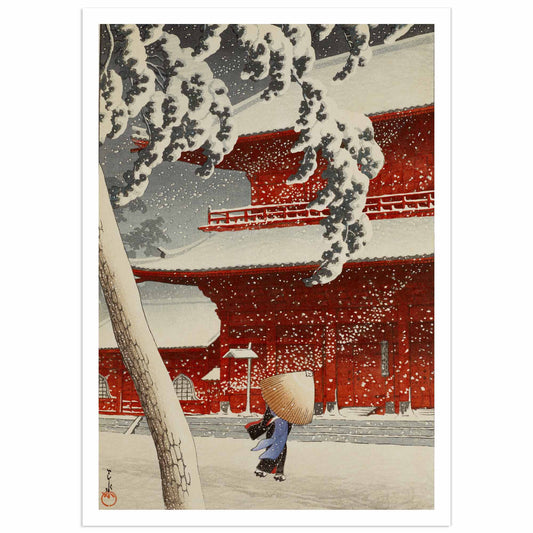
A lone figure crosses a snow-covered courtyard in front of a temple gate. The sky is a deep indigo. The only sound, you feel, is the hush of falling snow. This is the world of Kawase Hasui — a Japan of extraordinary stillness, of light catching wet cobblestones, of moonrise over a fishing harbour, of lanterns reflected in a black river. It is a world that never quite existed as he painted it, and that is precisely why it endures.
Hasui was the foremost landscape artist of the shin-hanga movement — the great early 20th-century revival of Japanese woodblock printmaking — and one of the most beloved Japanese artists of any era. In 1956, one year before his death, the Japanese government honoured him as a Living National Treasure. He produced more than 600 woodblock designs across four decades of relentless travel, observation and refinement. Today his prints hang in the Metropolitan Museum of Art, the British Museum, the Smithsonian and fine collections worldwide. They also hang, printed with museum-quality fidelity, on walls in Tokyo, Paris, New York and São Paulo. Their power to transport has not dimmed.
Rope Merchant's Son, Artist Against All Odds
Kawase Hasui was born Kawase Bunjiro on 18 May 1883 in the Shiba district of Tokyo, into a family of merchants — his father dealt in rope and thread. The name Hasui, meaning "water rushing from a spring", was given to him later by his teacher and master Kiyokata Kaburagi. From childhood he showed an exceptional gift for drawing, but his family steered him firmly toward commerce. For years he ran the family business while sketching from nature on the side, moonlighting as an artist while outwardly performing the role of a dutiful merchant's son.
When the business went bankrupt in the early 1900s, Hasui was finally free. He was already in his mid-twenties — an age at which Kiyokata Kaburagi, the great nihonga painter he sought out as a master, initially considered him too old to begin serious training. Kaburagi eventually relented, and through him Hasui encountered the publisher who would define his life's work: Watanabe Shozaburo, the driving force behind the entire shin-hanga movement.
It was Kaburagi who first noted in his student the quality that would characterise all his greatest work: an extraordinary sensitivity to atmosphere, to the specific quality of light at a particular hour in a particular season. Hasui did not paint generalised landscapes. He painted specific moments — a twilight he had witnessed, a snowfall he had stood in, a reflection he had bent to observe.
The Shin-Hanga Revolution
To understand Hasui, you need to understand shin-hanga — the "new prints" movement that Watanabe Shozaburo founded in the 1910s and championed until his death in 1962. Shin-hanga was born from a conviction that the great tradition of Japanese woodblock printing, which had produced Hokusai and Hiroshige in the 19th century, had declined into commercial mediocrity. Watanabe set out to revive it — and to do so by fusing it with what was new.
What was new was Western influence: the use of chiaroscuro, the rendering of atmospheric perspective, the suggestion of depth through tonal gradation rather than flat colour and outline. Hasui brought to this synthesis his own training in Western-style painting — oil and watercolour — and his ability to render light in a way that had no precedent in classical ukiyo-e. His night scenes in particular are technically astonishing: the gradation from deep indigo at the top of a print to pale reflected light on water at the bottom, achieved through the layering of multiple woodblocks, demanded craftsmanship of the highest order from the specialist carvers and printers employed by Watanabe.
Like all shin-hanga artists, Hasui designed his prints but did not cut the blocks or print them himself — that work fell to Watanabe's team of specialist craftsmen. The collaboration was close and exacting: Hasui was present during production, correcting proofs, adjusting colours, pushing the craftsmen to achieve what he had imagined. The results were prints of a refinement that rivalled anything in the history of the medium.
The Traveller: 600 Prints, One Country
Hasui's method was simple and relentless: he travelled. With sketchbooks under his arm, he crisscrossed Japan from Hokkaido in the north to Kyushu in the south, from the Pacific coast to the Sea of Japan, recording in pencil and watercolour everything that caught his eye: the angle of a temple roof in winter light, the surface of a canal at dusk, the particular shape of a mountain seen through morning mist. He travelled in all seasons and all weathers, deliberately seeking out conditions — heavy snow, driving rain, deep fog — that other artists avoided.
His collaboration with Watanabe produced over 600 woodblock designs — a body of work that amounts to a sustained portrait of Japan across four decades of rapid, often turbulent change. Hasui's Japan is, deliberately, a Japan of tradition: wooden architecture, narrow lanes, fishing boats, ancient shrines, moss-covered stone. Industrial scenes are almost entirely absent. Critics have sometimes argued that this represents a kind of nostalgic idealization — an image of Japan constructed partly for the Western collectors to whom Watanabe aggressively marketed shin-hanga. The critique has merit. But what is undeniable is the artistic quality: no other artist of the period captured the emotional atmosphere of the Japanese landscape with comparable consistency and depth.
Major Editorial Series
The work of Kawase Hasui is structured through both editorial series and recurring themes. His prints document a changing Japan while offering a poetic vision of landscape.
Souvenirs of Travel (Tabi Miyage)

Morning at Dōtonbori, Ōsaka (Ōsaka Dōtonbori no asa), from the series Souvenirs of Travel II (Tabi miyage dai nishū)
Published in the 1920s, this iconic series presents views from Hasui’s travels across Japan. Each print captures both the physical landscape and its atmosphere.
👉 A visual memory of travel and a key contribution to modern Japanese imagery.
Selected Views of Japan (Nihon Fūkei Senshū)

Tsukumojima in Shimabara, from the series Selected Views of Japan (Nihon fūkei senshū), woodblock print
This series presents carefully selected landscapes, highlighting Hasui’s structured approach and attention to seasonal changes.
👉 A comprehensive vision of Japan’s geography and beauty.
Twenty Views of Tokyo (Tokyo Nijūkei)

Yaguchi, from the series Twenty Views of Tōkyō (Tōkyō nijūkei)
Hasui depicts a transforming Tokyo, balancing modernity and tradition.
👉 A unique record of early 20th-century urban Japan.
Major Themes
Snow Landscapes

Snow at Tsukishima
Rain Scenes

Beach shed at Himi in Etchū Province, from the series Souvenirs of Travel II (Tabi miyage dai nishū), woodblock print
Night Landscapes

Gosaibori Canal, Niigata, (Niigata Gosaibori), from the series Souvenirs of Travel II (Tabi miyage dai nishū)
Temples and Traditional Landscapes

Tenno-ji, Osaka, from the series “Souvenirs of Travel III (Tabi miyage dai sanshu)
Hasui frequently depicted temples and traditional Japanese architecture, capturing a timeless vision of Japan in harmony with nature.
Loss, Resilience, and a Final Masterwork
Hasui's life was marked by catastrophic loss — twice. The Great Kanto Earthquake of September 1923 destroyed both his home and Watanabe's workshop, along with the blocks for all his pre-earthquake prints. Those early designs — considered by many to include his most original and expressive work — were never reprinted. They survive only in first editions, now among the rarest and most sought-after shin-hanga prints on the market.
Twenty years later, the firebombing of Tokyo in 1945 destroyed his home a second time. Through both catastrophes, Hasui rebuilt — not just materially, but artistically. His post-war work, produced in his sixties and early seventies, shows no diminishment of vision. His final print, Hall of the Golden Hue at Hiraizumi, was completed after his death and distributed at his memorial service in 1958. It is, by any measure, a masterwork.
Where to Find His Work Today
Original Kawase Hasui prints are held in major collections worldwide, including the Metropolitan Museum of Art (New York), the Smithsonian (Washington, D.C.), the British Museum (London), the Museum of Fine Arts (Boston), the Clark Art Institute (Williamstown), and the Tokyo National Museum. Original prints appear regularly at Christie's, Sotheby's and Bonhams, with first-edition pre-earthquake impressions commanding the highest prices.
Discover Kawase Hasui at Wallango
Wallango offers museum-quality reproductions of Kawase Hasui's most iconic landscapes — snow scenes, moonlit harbours, rain-soaked temples — printed on thick archival paper with exceptional colour fidelity. Bring the atmosphere of shin-hanga Japan into your home.
-
Tennoji Temple in Osaka – Kawase Hasui Print (1927)
Regular price From $29.94 USDRegular priceUnit price per -
Zōjōji Temple in Shiba – Kawase Hasui Print (1925)
Regular price From $29.94 USDRegular priceUnit price per -
Morning in Beppu — Kawase Hasui
Regular price From $29.94 USDRegular priceUnit price per -
Road to Nikko – Kawase Hasui Print (1930)
Regular price From $29.94 USDRegular priceUnit price per -
Ushibori — Kawase Hasui
Regular price From $29.94 USDRegular priceUnit price per -
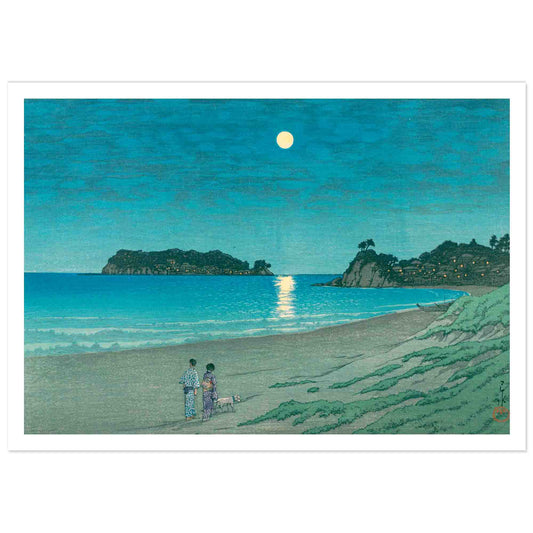
Seven-Mile-Beach, Sagami Province — Kawase Hasui
Regular price From $29.94 USDRegular priceUnit price per -
Ryûga Island, Oga Peninsula — Kawase Hasui
Regular price From $29.94 USDRegular priceUnit price per -
Sunset at Ichinokura, Ikegami — Kawase Hasui
Regular price From $29.94 USDRegular priceUnit price per