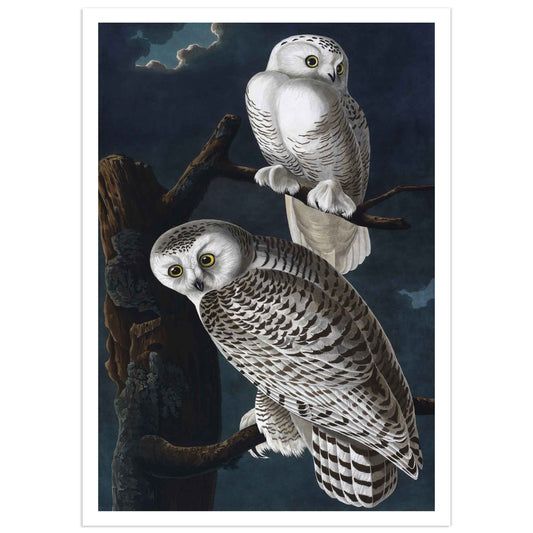
In the early 19th century, a man set out alone into the American wilderness with a gun, a sketchbook, and an impossible ambition: to paint every bird in North America, life-size, in its natural habitat. That man was John James Audubon. What he produced — 435 monumental hand-coloured plates, published in London and Edinburgh between 1827 and 1838 under the title The Birds of America — is not just one of the greatest achievements in the history of natural history illustration. It is one of the most extraordinary works of art ever made.
Today, fewer than 120 complete original sets survive. When one comes to auction, it sells for millions. But reproductions of Audubon's plates — faithful to every feather, every botanical detail, every dramatic pose — have made his vision accessible to all, and have lost none of their power to astonish.
A Wanderer Between Two Worlds
Born in 1785 in Saint-Domingue (present-day Haiti), the illegitimate son of a French naval officer and a Creole woman, Jean-Jacques Rabin was sent to France as a child and raised in Nantes under the name Jean-Jacques Audubon. At 18, he was shipped to America to escape conscription into Napoleon's army — and never really looked back. He settled at Mill Grove, his father's Pennsylvania estate, where he first began studying and sketching the birds around him with obsessive dedication.
The years that followed were turbulent. Audubon married Lucy Bakewell, moved to Kentucky, opened a series of shops and mills — all of which failed. By 1819 he was bankrupt, briefly imprisoned for debt, and supporting himself as a portrait painter and dancing teacher while Lucy worked as a governess to sustain the family. But through every setback, he kept drawing birds. And it was precisely this period of restless, impoverished wandering through the American frontier — from Florida to Labrador, from the Mississippi delta to the Gulf Coast — that gave his work its raw, lived-in quality. These were not birds seen through a laboratory window. They were birds he had watched, followed, and known.
A Revolution in Bird Art
Before Audubon, bird illustration was largely a static affair. Birds were depicted as stuffed specimens: upright, symmetrical, lifeless. Audubon broke that convention entirely. Working primarily in watercolour — supplemented with pastel, chalk, gouache and pencil — he developed a technique of propping freshly killed specimens on wire armatures to hold them in dynamic, natural poses, then spent up to sixty hours on a single plate.
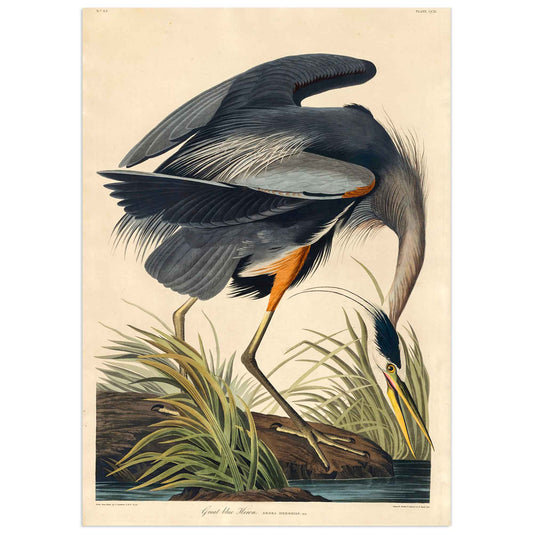
The results were unlike anything seen before. A great blue heron lunges for a fish. A pair of Carolina parakeets squabble over a cocklebur. A golden eagle tears into its prey. Birds are caught mid-flight, mid-dive, mid-song — alive on the page in a way no artist had achieved before. Critics sometimes called his compositions too theatrical, too romantic. His defenders called them true.
The double-elephant folio format he chose for The Birds of America — sheets measuring 99 by 66 centimetres — meant that even the largest species, like the American flamingo and the whooping crane, could be painted at full life size. It was an audacious technical and commercial choice, and it defined the look of the work entirely.
The Birds of America: A Monument of Publishing History
Unable to find a publisher in America, Audubon sailed to Britain in 1826 with 250 original drawings and a showman's instinct. He exhibited his work in Liverpool, Manchester and Edinburgh, charging admission, and was received with astonishment. The press lionised him as "the American woodsman" — a Romantic-era fantasy of the noble frontier naturalist that Audubon, never shy about self-promotion, was happy to inhabit.
He found his engraver in London: Robert Havell Jr., whose firm would spend thirteen years translating Audubon's watercolours into hand-coloured copperplate engravings of staggering refinement. The project was financed by subscription — subscribers received five plates at a time, one large bird, one medium, three small — and Audubon spent years criss-crossing the Atlantic to maintain his subscriber base, collect new specimens, and continue painting.
When the final plate was issued in 1838, The Birds of America comprised 435 plates depicting 497 species — including five that are now extinct, among them the passenger pigeon and the Carolina parakeet. It remains the most expensive printed book ever sold at auction.
A Complex Legacy
Audubon was a brilliant, driven, and deeply contradictory figure. He was also an enslaver, a plagiarist, and a man whose writings about frontier life were liberally embellished. The National Audubon Society, founded in his name long after his death, has in recent years grappled openly with this history. His work cannot be separated from the moral complexities of the world that produced it.
What endures, beyond the controversy, is the art itself. Audubon's plates captured species in their living environments at a moment of ecological abundance that would never return. Several of the birds he depicted had vanished within decades of his death. In this sense, The Birds of America is also an elegy — an involuntary record of a world already beginning to disappear.
Where to Find His Work Today
Original Audubon watercolours are held at the New-York Historical Society, which owns the largest collection. Complete or partial sets of The Birds of America are held by the National Gallery of Art (Washington, D.C.), the Natural History Museum (London), Harvard University, the Smithsonian, and many other major institutions worldwide.
Discover John James Audubon at Wallango
Wallango offers museum-quality reproductions of Audubon's most iconic plates, printed on thick archival paper with exceptional colour fidelity. Bring the golden age of natural history illustration into your home.
→ Explore our John James Audubon collection
→ Browse all Animal & Natural History Prints